
A Hidden Library Behind the Stairs in Rome: Notes from the "Hypothèse de lecture" Exhibition
Everyone knows Trinità dei Monti at the top of the Spanish Steps; most of us have snapped a photo and moved on. But very few people know that the church has a library founded in 1676. Once the quiet workspace of the Minim monastery, this library opened its doors after a lengthy restoration with a contemporary art exhibition. Trinità dei Monti is one of five French churches in Rome and an important landmark in the relationship between the two countries. For this very reason, the 40 artists participating in the exhibition are predominantly Italian and French.
Visiting exhibitions, going to libraries, and entering historic buildings — the things I enjoy most — had all come together under one roof, and for that reason I simply couldn't miss this exhibition.
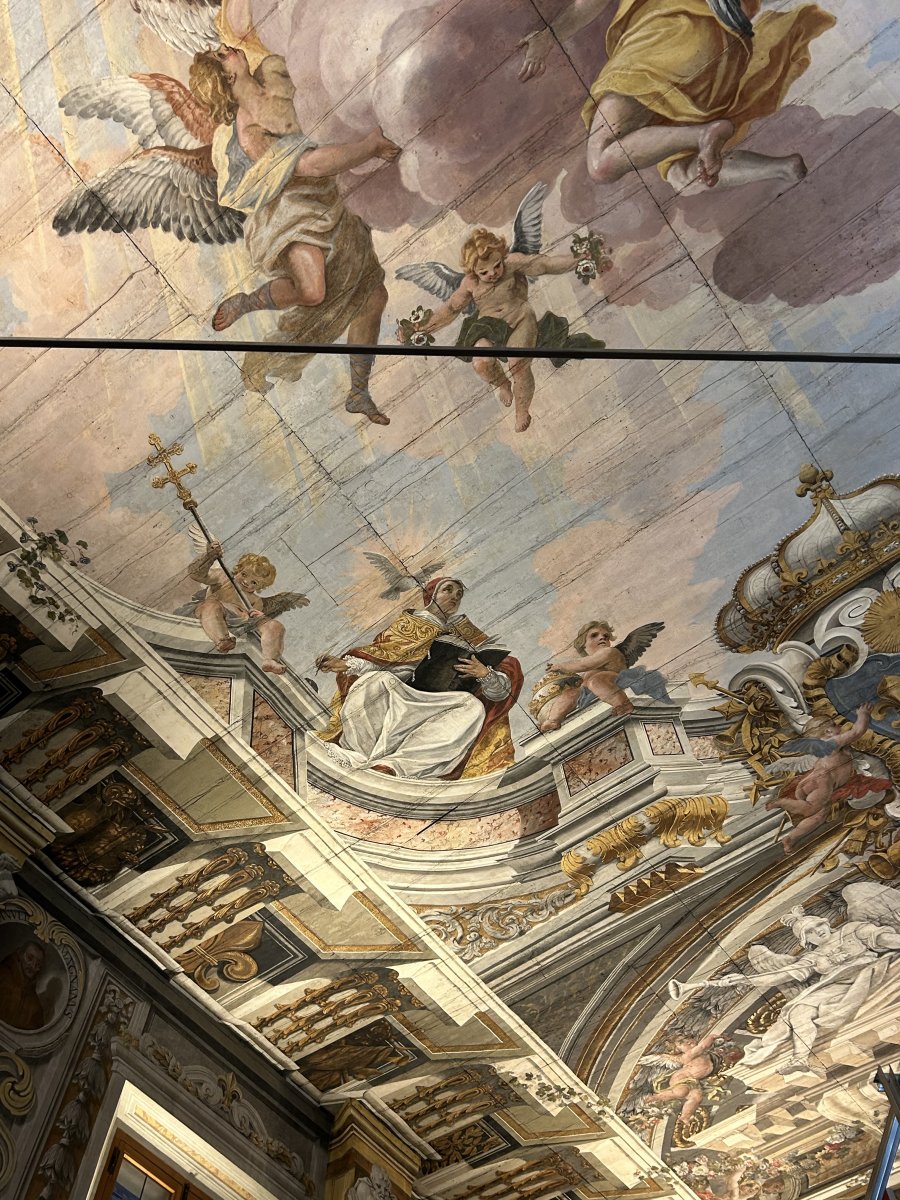
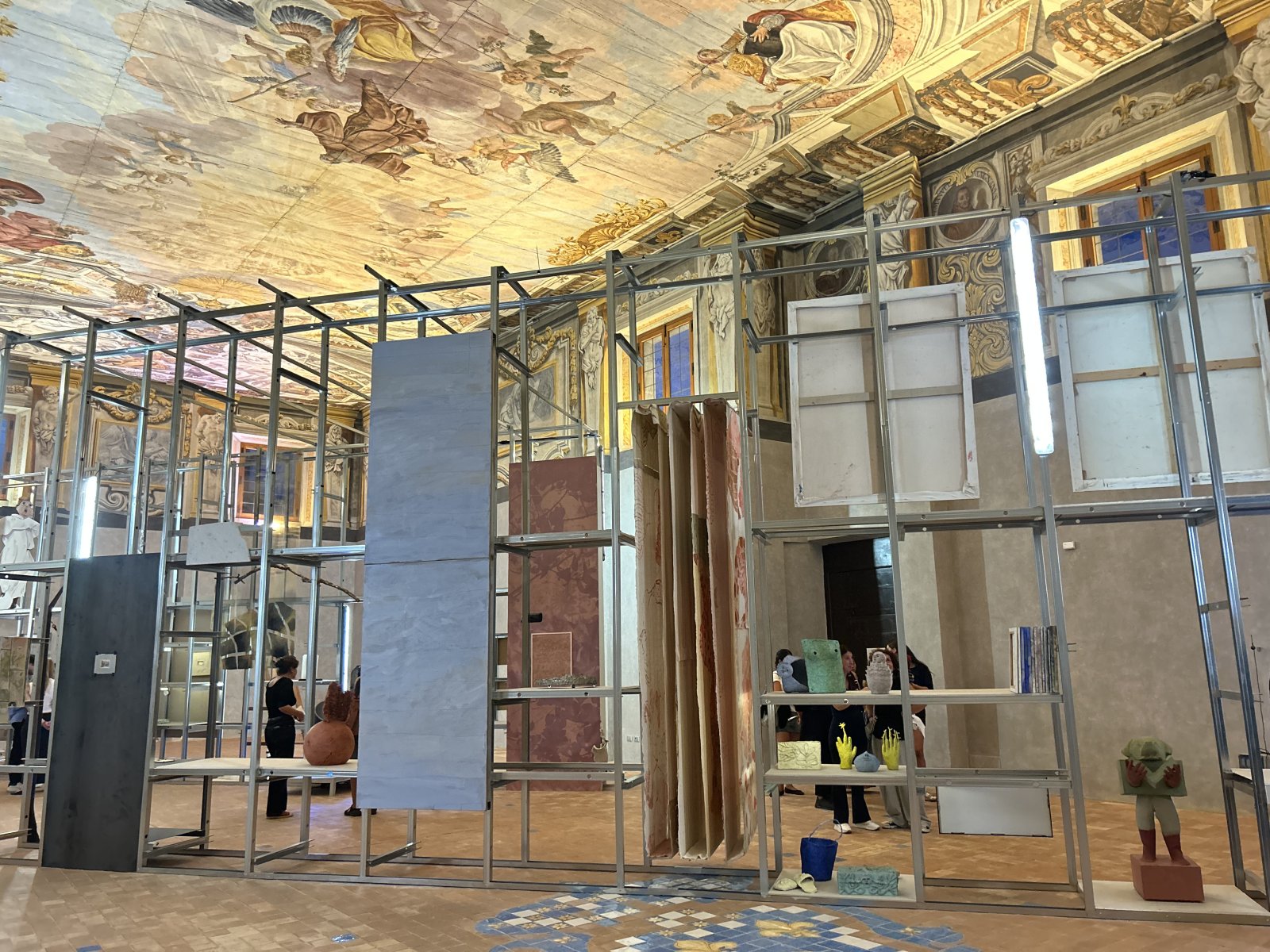
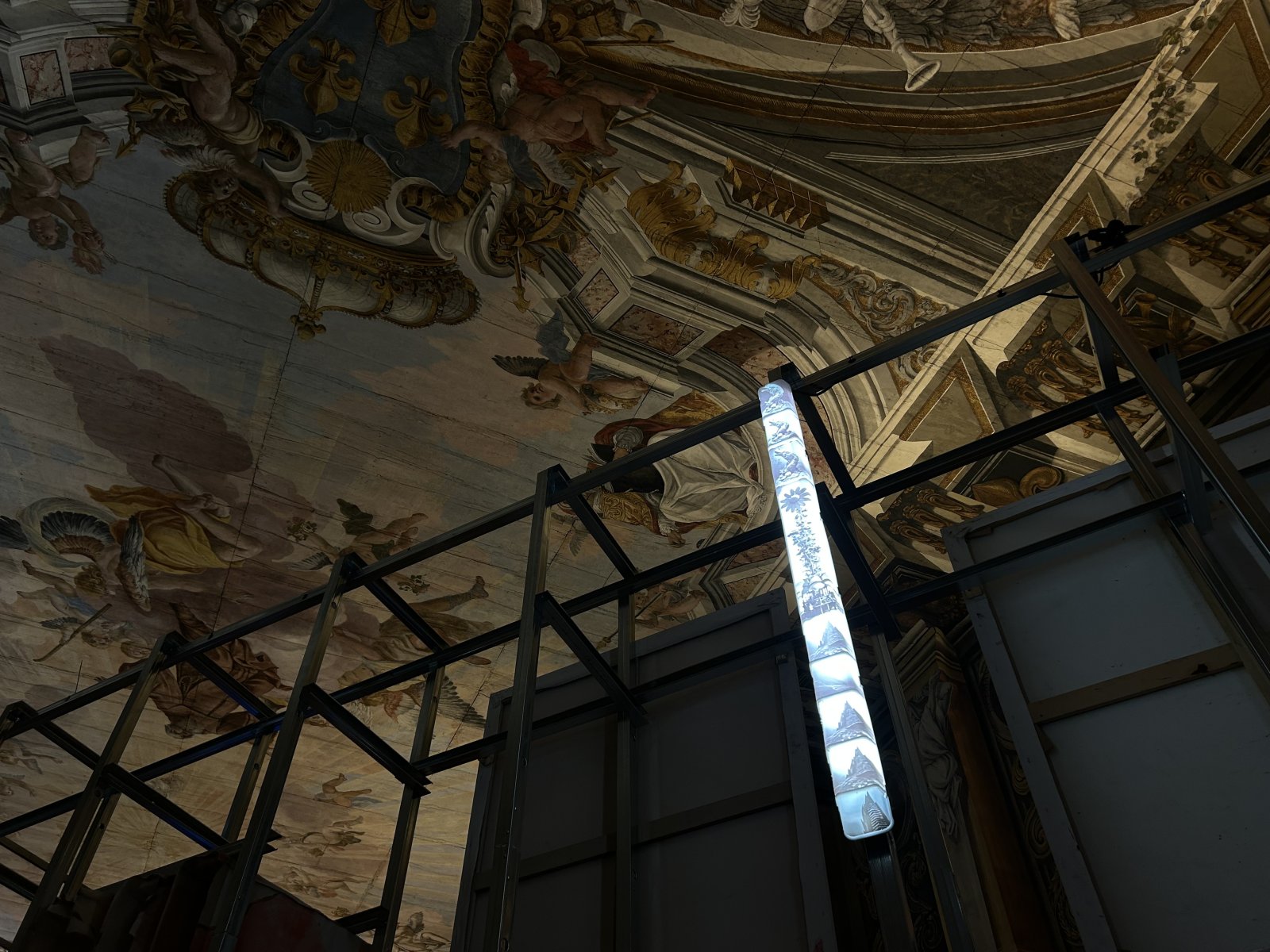
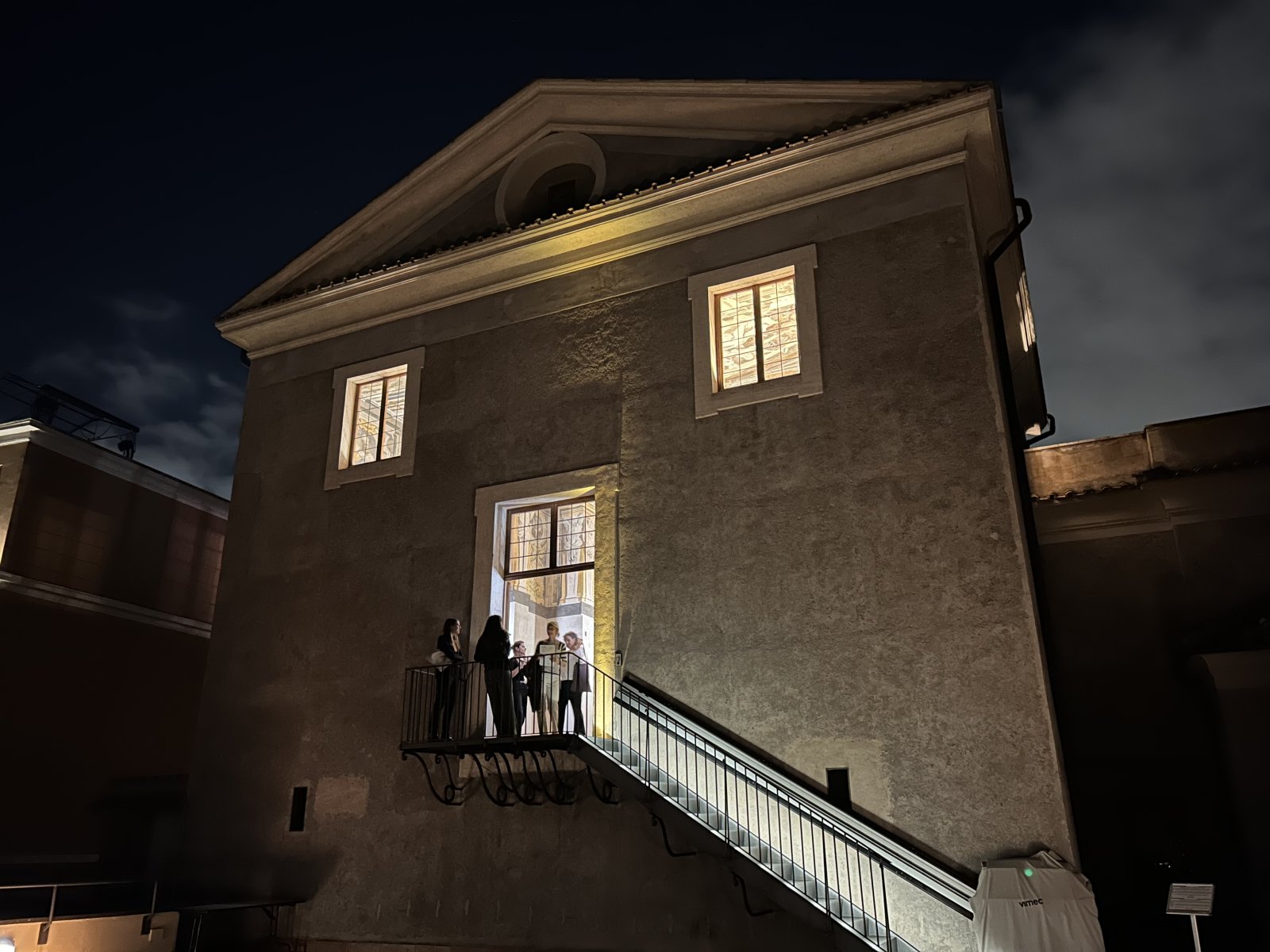
On the day of the exhibition, in the late afternoon, as the sun is setting, I make my way up from the Spanish Steps toward the church. To reach the library, you have to walk along a fairly long path behind the church, with a view of St. Peter's Basilica as your companion. This path and the view seem to prepare me for the exhibition I'm about to see. The library building, with its ancient and cubic structure, looks at first glance like a mysterious box concealing many secrets. The painted wooden ceiling visible through its two windows offers hints of what kind of space lies within. In that moment I think about how those who came here centuries ago looked upon the same sight. Because the building sits up high, I climb a staircase to enter. In contrast to the cold grey façade outside, inside there is a warm light dominated by yellow and orange tones; the colors of the wooden ceiling bring vitality to the entire space. The wooden ceiling, in all its grandeur, feels like a heritage looking down upon visitors from above… It carries figures from the Minim monastery and glows as if to recall the library's earliest days and all that it once held.
When I lower my eyes from the ceiling, I am reminded once again: this is a library without books. In 1798, with the French army's occupation of Rome, the library loses its collection of approximately 9,000 volumes, and a part of its identity is lost along with them.
But can identity truly be lost in this way?
The exhibition takes shape partly around this question. Its name is Hypothèse de lecture — "reading hypothesis": a proposition put forward to re-read and reinterpret the traces the space has lost. The works also enter into a dual dialogue with the library; on one side, the elements the building has preserved to this day (its history, architecture, painted wooden ceiling), and on the other, what it no longer holds.
As I think about the connections the works forge with the library in the context of past and present, the concept of "spolia" from Roman history comes to mind. In ancient Rome, artistic and historical elements taken from historic structures were used in the construction of another building. In other words, destruction and dispersal signify transformation rather than annihilation. In the same way, every work I look at gains meaning through the library; and the library, through them, re-reads what it has preserved and what it has lost.
Right at the center of the rectangular exhibition space, appearing in two separate pieces, is a "ghost architecture" designed for this exhibition by Belgian architect Olivier Goethals, inspired by the library's structure; each work is placed within this arrangement. The structure gives the space an order, but as I do at every exhibition, I am first drawn to the works that catch my eye and I don't follow the prescribed sequence.
No matter which corner of the exhibition you wander to, one of the works that accompanies you is "Mixed Feelings" by Ruoxi Jin. Two phones plugged in and charging, both in the middle of a call with the speaker on. The number one is calling is Casa (home), and the other is 112. The contrast between the place where we feel safest and emergency situations… A faint woman's voice rising deeply from the phones sings 'Tanti auguri a te' (happy birthday to you) over and over again. In this library where words were once stored, the words are repeated endlessly and at a certain point they begin to lose their meaning inside my head. If I were a Turk who didn't know the meaning of these words, would the work lose its significance or meaning?
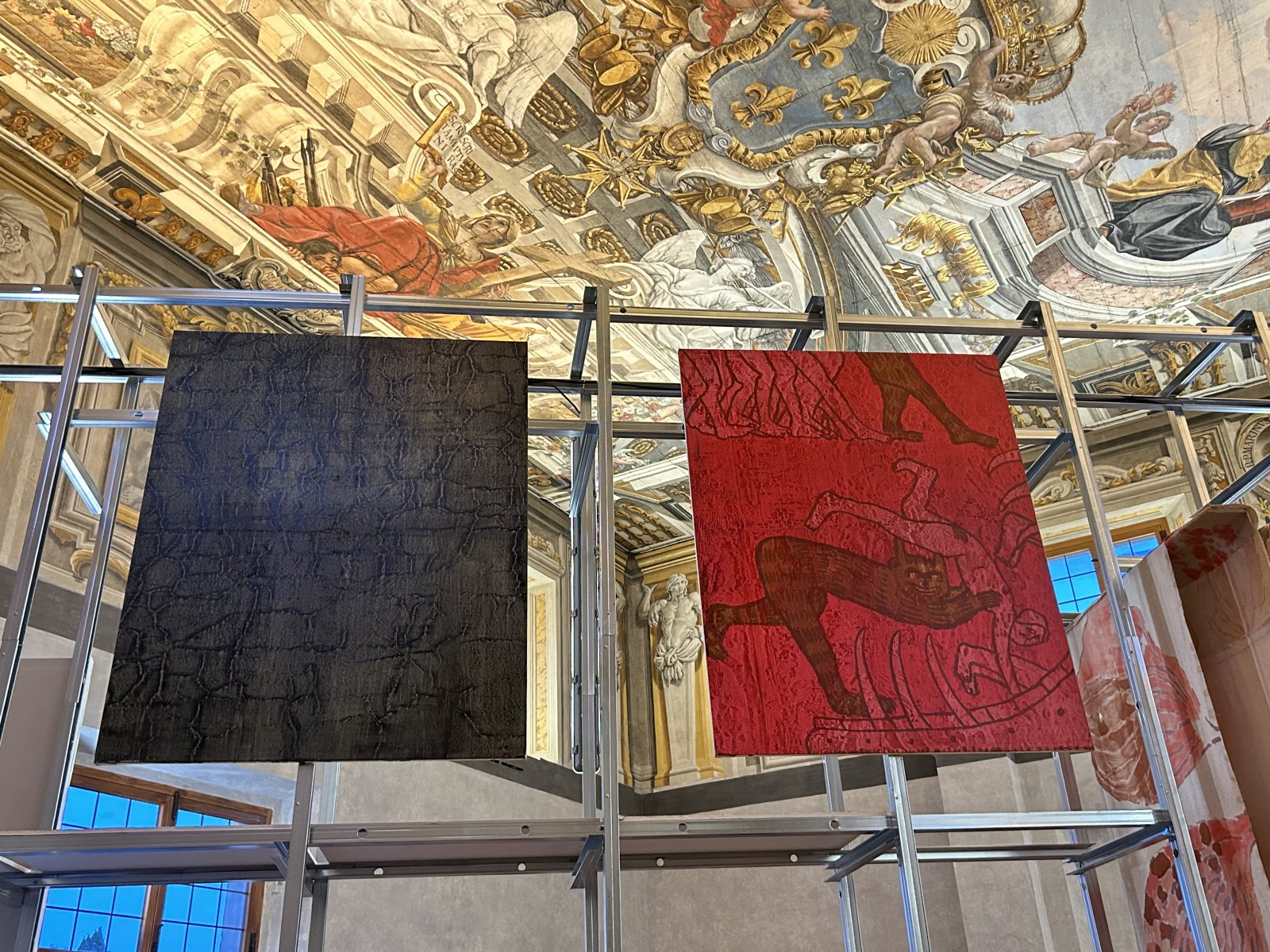
Right next to it I encounter Alexander Rączka's oil painting "Warm Greetings." This painting, reminiscent of medieval manuscripts whose margins were filled with tiny drawings, looks as though a book has been left open. Curling bodies, inverted figures, and arches reminiscent of ribcages evoke a scene of Judgment Day.
I keep walking. A photograph catches my attention.
Matisse Mesnil's work "Ricordo di uno sconosciuto" (memory of a stranger) consists of an old photograph from the artist's archive and an intimate text written on its back, describing a home interior in the first-person singular. The photograph is set in a semi-transparent, hazy-looking metal frame; as people pass behind it, look at it, or touch it, the work shifts shape along with them. While thinking about photographs and the analog memory they carry, I find myself in front of a work called "Portals." This work, with a mirror placed inside it, reflects the wooden ceiling and reminds me of where I am and what this place has held.
These works make me think about time and memory: how human memory and collections fragment and disappear over time.
As I move through the exhibition, I come across a double-sided oil painting by Giulio Catelli, one of my favorite artists: "Autoritratto alla finestra" and "La grata della finestra." Looking at Catelli's soft color tones — he usually works outdoors and includes scenes from everyday life — always brings me joy.
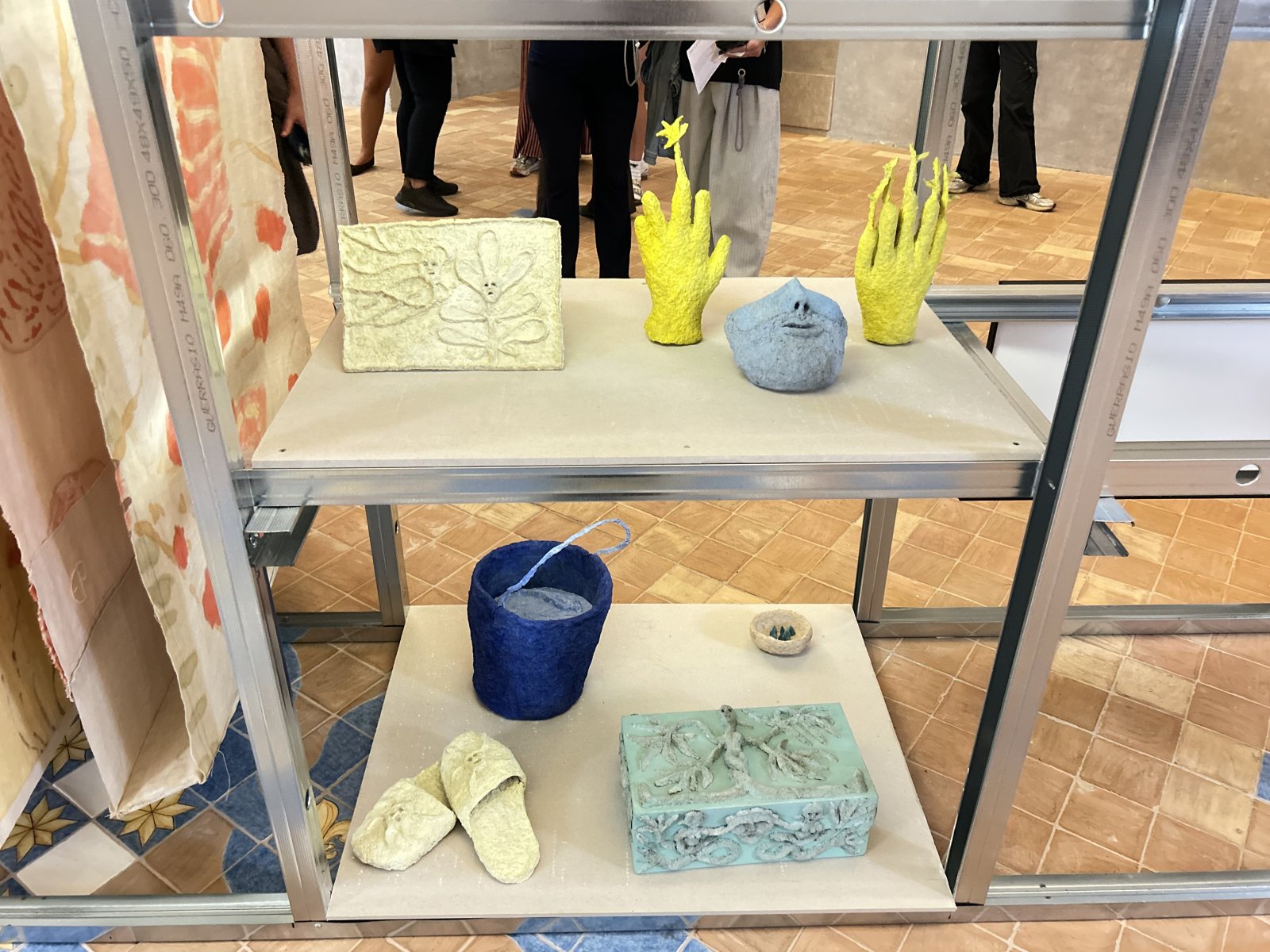
Valeria Carrieri's "Guerriera d'Amore," made from painted papier-mâché, gives you the feeling of belonging to another world. The structures here and there evoke mythological creatures and transformed plants, yet at the same time draw equally from the everyday; to me it feels like an intriguing interpretation of ordinary objects rendered personal.
As I near the end of the exhibition, Pierre Gaignard's LED neon installations catch my attention. On the backlit surface of slender, tall, vertical light columns standing at various points throughout the exhibition space, mask-like faces resembling porous stone repeat themselves; below, a segmented figure that is half human, half worm, and at the very bottom, a perforated mass evoking a cave wall. The images recall a prehistoric artifact, yet their origins lie in artificial intelligence: Gaignard reconstructs historic botanical forms using AI and processes the resulting hybrid images into neon covers via 3D printing, adapting them to the lithophane technique. The images appear only when lit from behind.
Each work has its own essence, its own world. As I walk among them, I think about how every book that once stood here also had its own world. I find myself wondering what kinds of books they were, and whether those books and the works here today intersect at any point. Perhaps the answer lies in the space itself: this structure from the late 17th century and the works made centuries after it exist in an intriguing tension and harmony. They diverge from one another and yet blend into one another. Both this building and the works within it make reference to the history and remnants of the city they inhabit. They make me think about what has been forgotten, what remains in the archive, what has been erased forever, and how word and image complete or destroy each other. I believe libraries are truly magical spaces for staging exhibitions.
When I step outside, darkness has fallen over Rome. With the works still on my mind, I descend along the path I came by. In the distance, St. Peter's Basilica glows brilliantly, visible from every corner of the city thanks to its immensity. The library remains behind me: perhaps without its books, but not without a voice — having come back to life centuries later.