
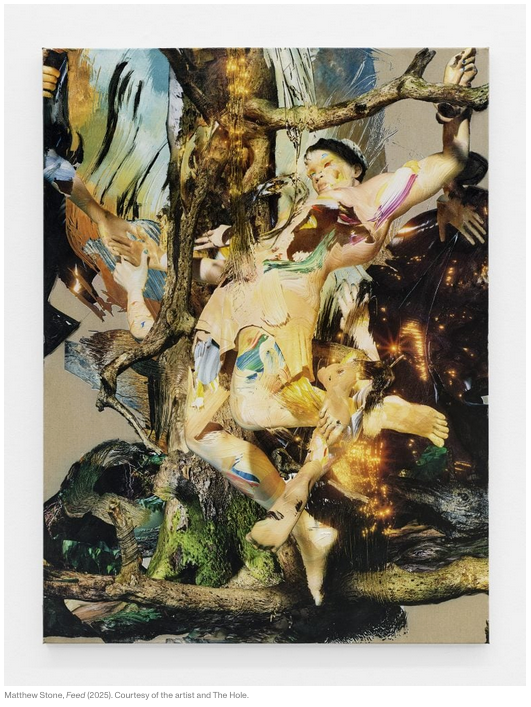
AESTHETIC POLLINATION
In the noise of the visibility economy, confronting history is not a choice; it becomes a condition of aesthetic survival.
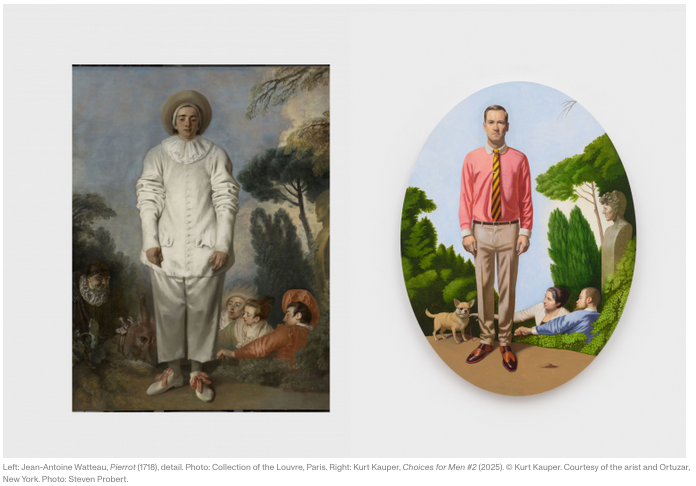
In art history, influence has never been mere imitation. When the Romans revived Greek mythology, when Renaissance masters internalized the ancient sculptural canon, or when Picasso repeatedly reinterpreted Velázquez's Las Meninas, what was at stake was not the copying of a source text; it was its assimilation and transformation. This process resembles pollination in botany: material taken from one organism produces an entirely different life form in another organism.
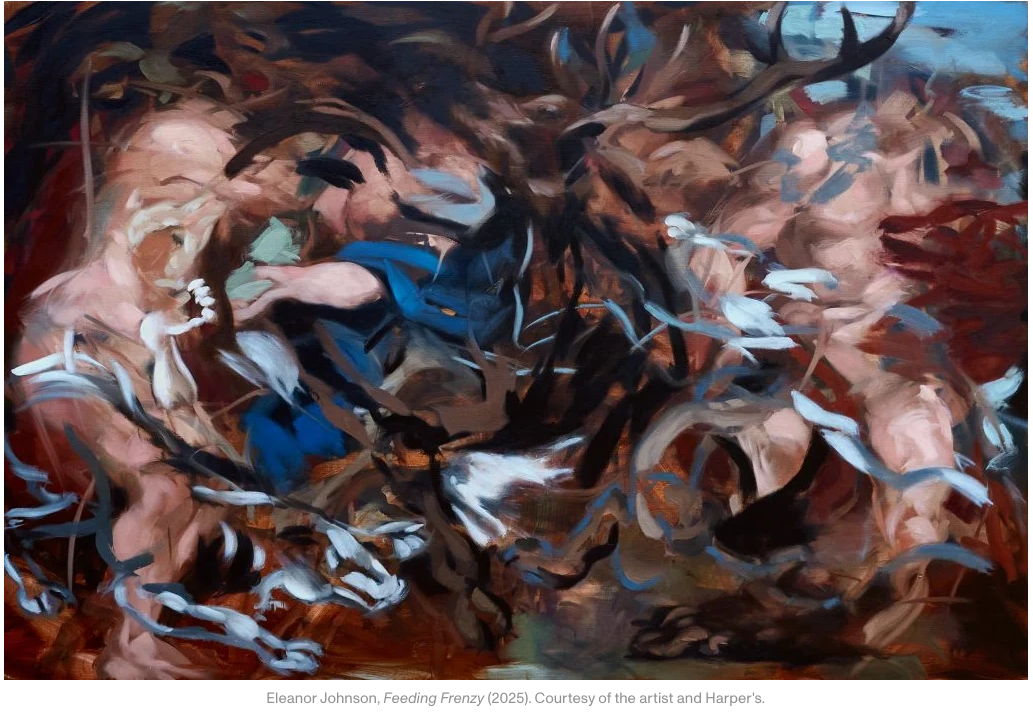
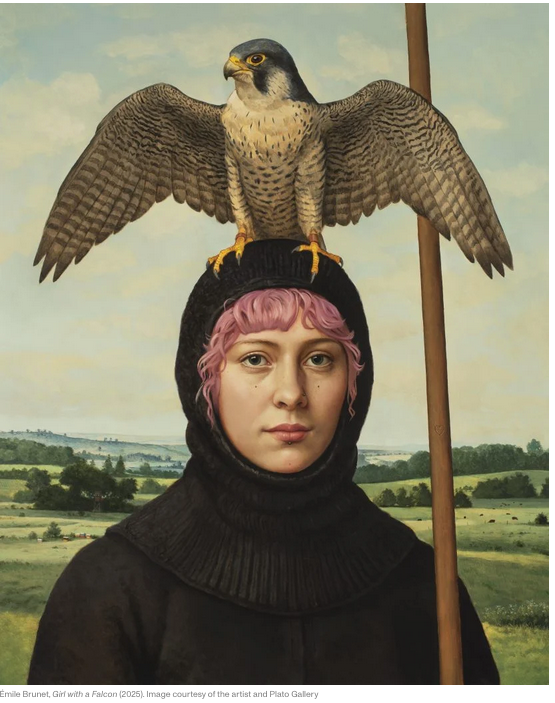
Today, this pollination process has both intensified and become more fragile. While historical images are instantly accessible in the infinite expanse of digital archives, the issue for artists is no longer "what can I access" but has transformed into the question "what can I truly make contact with." Émile Brunet's relationship with Northern Renaissance materials or Eleanor Johnson's revival of Rubens' alla prima technique are concrete examples of this deep need for contact. Reference is not a decorative element; it is an experiment through which the artist tests their own existence against history.
Today's art field appears more productive than ever before in history. Exhibitions are increasing, artists are multiplying, images enter global circulation within seconds. However, this expansion also brings with it a fundamental question: Is production really increasing, or is it merely circulation?
While images multiply rapidly through algorithms, platforms, and AI-assisted production tools, this speed often does not advance in parallel with intellectual intensity. What emerges is not the opposite of production, but a more complex situation: non-production. Exhibitions take place, works are produced, content is shared; but this movement often does not create a new aesthetic risk or intellectual investment. The art object transforms from an experimental field into an entity positioned within the market.
Marshall McLuhan had warned in the 1950s that the electronic network would initiate an "anxiety network"; easy access to mass media would dull the senses, weaken critical thinking, and lead to a kind of collective numbness. According to him, only artists could resist this numbness. The gallery landscapes of 2026 show that he was right.
From a capital perspective, this relationship between art history and contemporary production is not surprising. Today's art market no longer produces only works; it produces stories, references, and trust. In an age of uncertainty, historical lineage functions like a kind of guarantee mechanism. Reference stabilizes the work's value not only aesthetically but also perceptually.
As Harper Levine, owner of Harper's gallery, puts it, "we are exposed to an ocean of disposable images in daily life," and in this ocean, works rooted in history feed the viewer's longing for recognizable aesthetics. Elena Platonova, founder of Plato, emphasizes that this connection is not mere nostalgia: aesthetic continuity established with cultures that have risen and fallen over centuries functions as an existential balance against today's rapid change.
However, a delicate tension also emerges here. As reference multiplies, risk decreases; as risk decreases, innovation also narrows. While art production becomes more readable from a market perspective, the space for creative leaps may shrink. This balance between market confidence and aesthetic discovery also carries the danger of reducing historical reference to merely a marketing strategy.
Most meaningful historical pollinations occur not at a conceptual level, but through the body and hand. Brunet's preference for working only with Kama Pigments paints or Johnson's layer-by-layer reconstruction of Rubens' wet-on-wet technique is an expression of this material commitment. To borrow McLuhan's famous phrase: the medium is the message. The grip of the brush, the light filtering through the texture of paint, the acid of the paper carrying the painting — all of these activate a much deeper historical memory than mere formal references.
This material memory removes the artist from being merely a reader of history; it transforms them into a practitioner sharing a common bodily experience with history. A face kneaded with Holbein's pigments is not an art historical quotation; it is a muscle memory left behind by four hundred years of hands. Johnson's conscious decision to leave pentimenti — correction traces visible beneath the canvas — also feeds from this spirit: the thought process precedes the result.
The artist surrounded by the digital environment now struggles not only with their own language but with data density. In the endless flow of images, originality begins to be measured not by production quantity but by meaning intensity. Therefore, some artists' return to material, history, and time is not a romantic reflex; it is a redefinition of value production.
Johnson's attraction to Baroque intensity can be read almost as a defense reflex in this context: "Most of us live lives exposed to intense, fast-paced information bombardment," she says, finding reflection of this saturation feeling in Rubens' excess. History is not escape; it is the cipher of the present.
What is happening in the art field today is not stagnation, but a repositioning. In the age of non-production, the real issue is not producing more works; it is being able to distinguish production that truly increases aesthetic capital. Deep dialogue established with history continues to be one of the most powerful tools of this distinction.
Because in the art market of the future, value will emerge not from noise, but from intensity. And the most ancient source of that intensity is the aesthetic pollen accumulated over ages.