
Muzaffer Kurt
"Painting for me is not about seeing, but about making you feel."
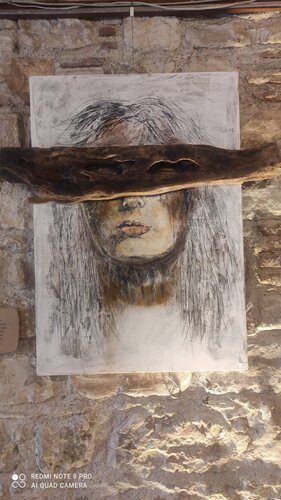
In my works, I use materials such as graphite pencil, colored pencil, oil pastel, chalk pastel, acrylic, artistic paste, and oil paint. Each one finds its place according to the emotion I want to convey.
For me, the surface I will work on is just as important as the materials themselves. I am not limited to canvas; I work with old windows, wooden surfaces, and materials that carry traces in their texture.
Sometimes I apply paint layer by layer, sometimes I wipe it away, redo it, and age the surface. I use spatulas in as many different sizes and dimensions as I use paintbrushes. I seek not smoothness, but texture and truth.
My figures are often silent. Through windows and interior spaces, I convey not what lies outside, but the emotions that remain within.
If someone looking at a painting finds something of themselves in it, that work is complete.
Muzaffer Kurt, after working in the banking sector for many years, retired and devoted his life to painting, to which he is passionately dedicated. His artistic journey, which began with drawing human figures in his childhood years, has continued over the years as he developed a unique pictorial language. In his works, which foreground light, shadow, and strong color transitions, he explores human experiences, old houses, windows, and spaces that resist the passage of time.
He presented his first solo exhibition "Lost Directions" to art lovers, bringing together oil paintings themed around nature and humanity.
He later turned to using recycled materials — particularly old windows and doors — as canvases in his works, developing a unique approach that merges the traces of the past with today's aesthetic sensibility. In the exhibition "The Rhythm of Life Through the Window," one of the most significant examples of this vision, he interpreted each window as a symbol of a life, and each door as a symbol of new beginnings.
He summarizes his artistic philosophy with these words:
"For me, painting is not about seeing, but about making others feel. Every brushstroke tells the story of a lived moment, a forgotten street, or a window silently waiting."