
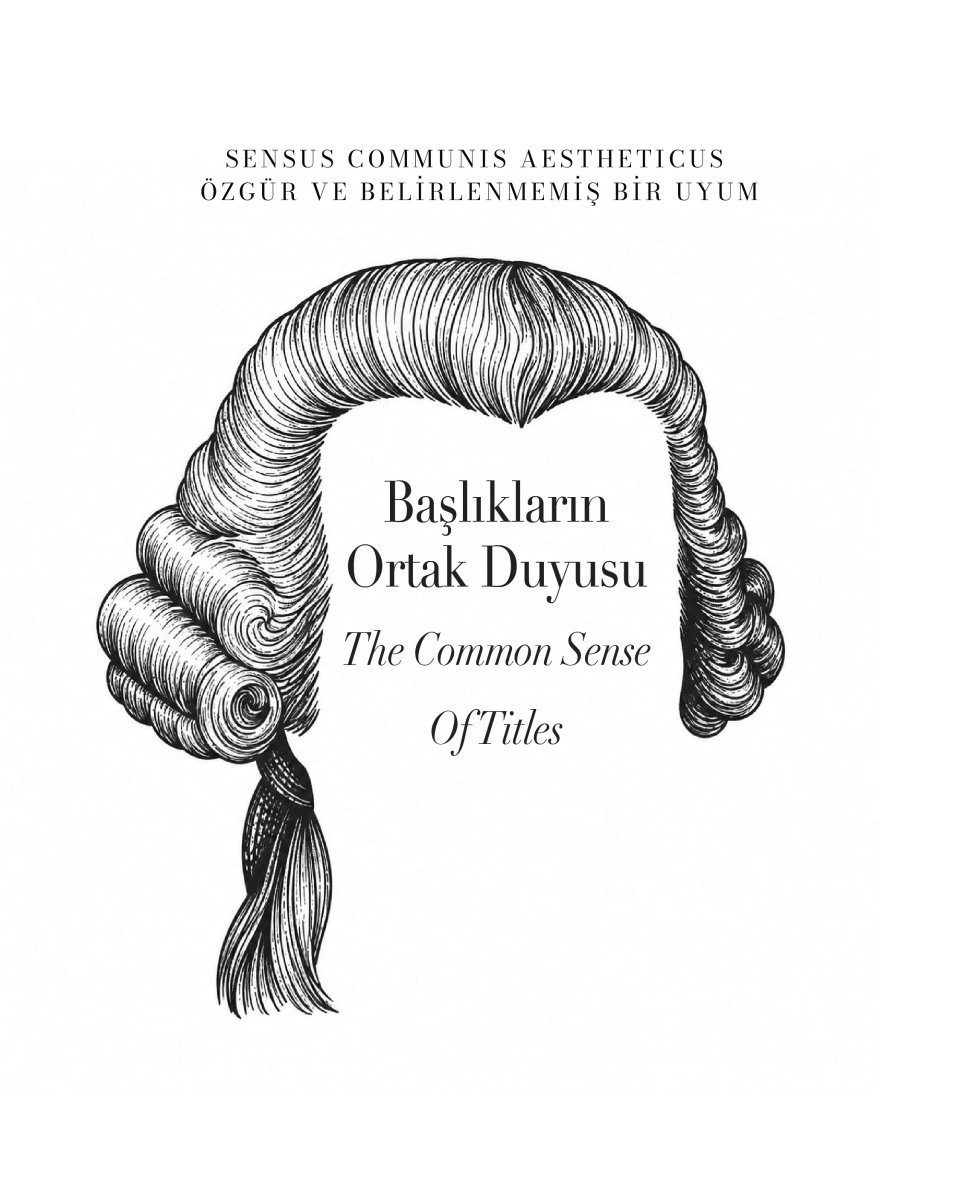
Common Sense of Titles

We melted the exhibition titles of 2026 into a single crucible. What remained at the bottom was a philosophy.
Collecist · Review File · Oct 7, 2026
We placed approximately thirty exhibition titles from around the world and Turkey side by side, all from within a single year. The titles did not scatter; they gathered into four nodes: the cave, the trace, opacity, the archive. The common denominator of all four is a single question: How do you show something that is not fully visible? This is very close to what Kant called "common sense" more than two hundred years ago. But the same crucible also offers a warning: common sense is on the verge of becoming a common mold. Our own titles are inside this crucible too.
We built a crucible
This article is not about a single exhibition, but about the titles of exhibitions.
Our method was simple: we collected the titles of exhibitions that have opened from the end of 2025 to the present. From Dubai to Venice, from Johannesburg to Brooklyn, from Mersin to Beyoğlu. Then we put them in a crucible and melted them down — that is, we looked at which words, which images, which thinkers kept recurring.
Let us say upfront that this is not a scientific count. A crucible, an observation. But the result came out too orderly to call coincidental.
Our question was this: Are today's conceptual artists, through the titles they place without knowledge of one another, arriving at a philosophical convergence?
Our answer: Yes. At four distinct points, no less.
What remained in the crucible: Four nodes
1. The Cave
Plato's cave became 2026's most revisited image.
At the Venice Biennale, the Greek Pavilion, through Andreas Angelidakis's Escape Room installation, reconstructed the cave through the lens of nationalism, cultural memory, and identity. In New York, Lichtundfire opened a group exhibition titled Allegory of the Cave. In Brooklyn, a gathering was held under the name Plato's Cave. In France, Cédric Fargues's exhibition was called Plato's cave is empty. And an award-winning installation at Ars Electronica in Linz rewrote the cave through artificial intelligence: a character that exists only as shadow.
In Istanbul, Karanlığın Hafızası (Memory of Darkness) framed the cave as a space of memory. At Zilberman, Sandra del Pilar's exhibition was titled Boşluklar ve Hayaletler (Voids and Ghosts).
The cave's return is no coincidence. Plato's question was whether the image we see is real. In an age when trust in the image has been shaken and screens and artificial intelligence generate shadows, this question is once again current.
2. The Trace
The second node is the word trace itself.
In South Africa, the annual exhibition at KZNSA Gallery was titled Traces. In Berlin, TRACE. Angelika Addison's solo exhibition, Traces and Pages. Turkish artist Hasan Yiğit's print exhibition, Trace, Transfer & Transform. The works of Felix Gonzalez-Torres are being re-exhibited under the title the traces of memory. In Mersin, Serkan Günenç's ceramics exhibition was called Mimari Belleğin İzleri (Traces of Architectural Memory).
In philosophy, a trace is the continued presence of something that is no longer there. Neither full presence nor full absence. All of these exhibitions, in their texts, describe this in-between state — what remains, what has been erased, what has worn away.
3. Opacity
The third node has a thinker behind it: the Martinican poet and philosopher Édouard Glissant.
Glissant's "right to opacity" — the idea that a person need not be fully understood — became the foundation of at least three exhibitions in 2026. At Efie Gallery in Dubai, In Abstracto, In Concreto read bodies through this concept. There Are Other Worlds (They Have Not Told You Of) in Johannesburg addressed African abstraction through opacity. And an exhibition at an independent venue in Germany was titled directly Opacity and Light.
Here the philosopher is explicitly invoked. But the question being asked is the same as in the other nodes: How do you show the invisible without making it visible?
4. The Archive
The fourth node is the archive and memory.
Syrian artist Ahmad Tallaa's exhibition is titled The Living Archive. In his view, the archive does not reside on a shelf but in the face that a person carries. In Venice, Vyacheslav Akhunov's exhibition Instruments of the Mind also transforms a space into a living archive. In Istanbul, Bir Yaka, İki Hikâye (One Shore, Two Stories), Hatıramı Sakla (Keep My Memory), Kesintisiz (Uninterrupted), and Kadınların Göç Hafızası (Women's Migration Memory) all draw from the same vein.
In philosophy, the archive is not merely the place where documents are kept; it is the question of who decides what is remembered. Most of these exhibitions treat what lies outside the official archive — what is carried in the body, in the family, in the home — as archive.
The common denominator of the four nodes
Cave, trace, opacity, archive. All four come from different intellectual traditions. But the same thing remains at the bottom of the crucible:
The art of 2026 is not concerned with the visible, but with what the invisible leaves behind.
A shadow is not the object itself, but what it leaves behind. A trace is what the departed leaves behind. Opacity is the void left by what cannot be understood. The archive is what time leaves behind.
Today's conceptualists, without knowledge of one another, seem to have gathered around a single philosophical question: the in-between space between presence and absence. In our reading, the reason for this is that we are living in an age when images have never been so abundant, and never so suspect.
This is where Kant comes in
In the Critique of the Power of Judgment (1790), Kant speaks of two things.
The first is that the imagination can produce images that do not fit neatly into any single concept yet set the mind working intensely. Cave, trace, opacity, and archive are precisely such images: none of them closes into a single definition.
The second is sensus communis aestheticus, that is, aesthetic common sense. This is not everyone thinking the same thing; it is the condition under which a feeling can be shared with others. According to Kant, in this experience the faculties of the mind work together without imposing on one another, in a free and indeterminate accord.
The titles in the crucible can be read as a trace of such common sense. Artists who do not know one another have asked the same question through the same images.
But the crucible also offers a warning
When a word is used for the first time, it is an aesthetic image. When it is used for the sixth time, it becomes a label.
This is the most striking finding from the crucible: within a single year, by our count alone, the word trace appears in the title of at least six exhibitions. When a viewer walks into an exhibition titled Traces, what they are supposed to think has already been told to them before they see the first work.
In Kant's terms: the accord is no longer indeterminate. The title settles the free play of the imagination at the door.
That is to say, the line between common sense and common mold has grown thin. Asking the same question is a convergence. Using the same word, more often than not, is a convenience.
Our own crucible
We cannot write this piece from the outside; our own titles are inside the crucible too.
Our first selection was titled Belirsizlik Çağında İmge (Image in the Age of Uncertainty). The opening work was Sevil Çetin's photograph titled Kimlik / Temsil / Çözülme (Identity / Representation / Dissolution). In the selection's text, we ourselves invoked Baudrillard, Foucault, and Butler. This title fits comfortably into the opacity and trace nodes of the crucible.
But did the work transcend the title?
In our view, it did. In Sevil Çetin's work, white layers flowing over black simultaneously construct and erode the portrait. Beneath the dissolving surface, a single eye remains. That eye says more than the three words of the title. The imagination is still free there.
Our second selection, Evcilleşmeyen Üretim (Production That Refuses to Be Domesticated), does not fit into any of these four nodes; it looks not at the residue but at production itself. Whether that is sufficient, the viewer will decide.
After reading the title
The conclusion that emerges from this crucible is not that artists are secretly reading philosophy. The language of the art world has so thoroughly internalized the concepts of more than two centuries of aesthetic thought that the artist poses the philosopher's question without naming the philosopher.
This is a richness. But also a danger.
So a suggestion to the reader: when you read an exhibition title, notice which node it belongs to. Cave, trace, opacity, or archive? Then look at the work and ask a single question: Does this work transcend its title?
If it does, what Kant called common sense is at work in that moment, between the artist and you. If it does not, what stands before you is not a convergence but a mold.
Appendix: Titles in the crucible
Cave and shadow
Escape Room — Andreas Angelidakis, Greek Pavilion, 61st Venice Biennale, 2026
Allegory of the Cave — Lichtundfire, New York, May–June 2026
Plato's Cave — kin, Brooklyn, August 2026
Plato's cave is empty — Cédric Fargues, Sympa, Capdenac, November 2025–January 2026
Plato's [AI]legory of the Cave — MIT team, Ars Electronica, Linz, September 2026
Karanlığın Hafızası — Haliç Sanat, Istanbul, through February 2026
Boşluklar ve Hayaletler — Sandra del Pilar, Zilberman, Istanbul, through January 2026
A passing shadow and a vanishing cloud — Avital Burg, Nazarian / Curcio, Los Angeles, April–May 2026
Trace
Traces — KZNSA Gallery, South Africa, April–May 2026
TRACE — Berlin, June–July 2026
Traces and Pages — Angelika Addison, July 2026
Trace, Transfer & Transform — Hasan Yiğit, Versus Arts, June 2026
Felix Gonzalez-Torres and the traces of memory — July–October 2026
Mimari Belleğin İzleri — Serkan Günenç, Toros University, Mersin, April–May 2026
Opacity
In Abstracto, In Concreto: On Memory and Presence — Efie Gallery, Dubai, May–September 2026
There Are Other Worlds (They Have Not Told You Of) — FADA Gallery, Johannesburg, February–April 2026
Opacity and Light — THE SPACE //, Germany, 2026
Archive and memory
The Living Archive — Ahmad Tallaa, Firetti Contemporary, September–November 2026
Instruments of the Mind — Vyacheslav Akhunov, Palazzo Franchetti, 61st Venice Biennale, 2026
Bir Yaka, İki Hikâye — Metrohan, Istanbul, 2026
Hatıramı Sakla — Metro Han, Istanbul, 2026
Kesintisiz — Istanbul, 2026
Kadınların Göç Hafızası — Women's Library, Istanbul, 2026
Thread
The Event of a Thread — ifa traveling exhibition, Museo Tamayo, Mexico City, September 2026
Coded Threads — Skissernas Museum, Lund, 2026
Collecist
Belirsizlik Çağında İmge — Collecist Selection #01
Evcilleşmeyen Üretim — Collecist Selection #02
Sources
HENI — Angelidakis, Escape Room
ArtRabbit — Allegory of the Cave
Contemporary Art Library — Cédric Fargues
MIT Media Lab — Plato's [AI]legory of the Cave
GZT — Istanbul exhibitions, January 2026
ArtRabbit — Trace, Transfer & Transform
Felix Gonzalez-Torres Foundation
Toros University — Mimari Belleğin İzleri
Efie Gallery — In Abstracto, In Concreto
ARAK Collection — There Are Other Worlds
Museo Tamayo — The Event of a Thread
Immanuel Kant, Critique of the Power of Judgment (1790)
Credits
Date:
7 Eki 2026
Category:
Tag: