
Representational Stages: Mid-Town Dialogues
TR
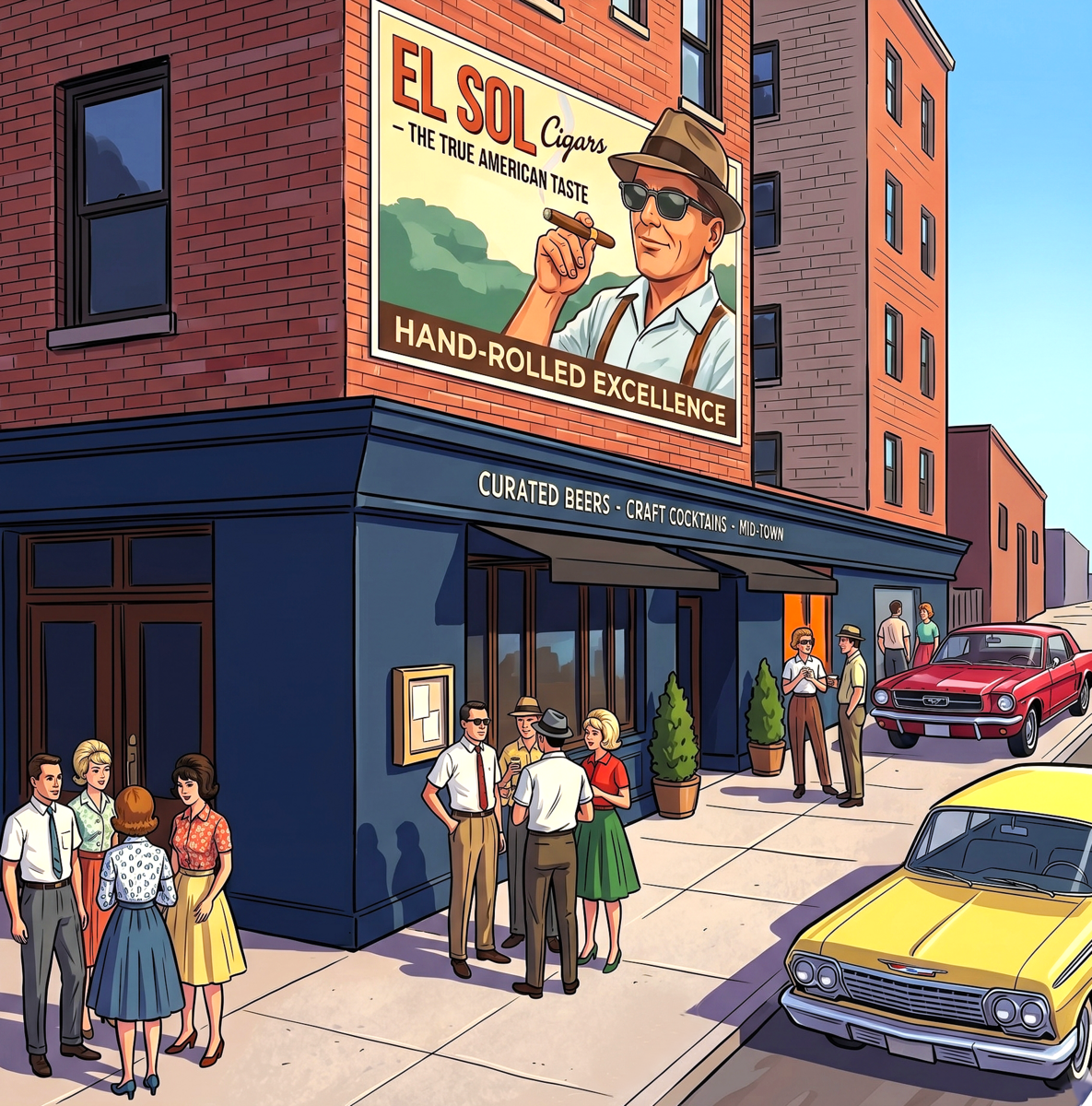
This artwork examines the place of modern individuals in urban life and their modes of socialization. The conversations among the people at street level (micro-interactions) confront the world of consumerism imposed by the massive billboard above them (macro-structures). Utilizing a nostalgic atmosphere, the artist sociologically questions how urban spaces and commercial advertisements shape our identity, desires, and social relationships.
$ 2,500
Soner Piskin' More From
Representational Stages: Mid-Town Dialogues
The visual narrative operates on multiple planes of sociological inquiry. At the street level, small clusters of figures engage in localized, performative socialization outside a mid-town establishment offering "Curated Beers & Craft Cocktails." Simultaneously, an over-scaled, idealized commercial billboard advertising "El Sol Cigars: The True American Taste" looms overhead, acting as a structural panopticon of capitalist desire that defines the identity of the very subjects beneath it.
Sociological Analysis & Theoretical Framework
To fully comprehend the deep social layers within this artwork, it is essential to invoke the spatial theories of Henri Lefebvre and the structural observations of Jürgen Habermas. The sidewalk portrayed is not merely a physical conduit for foot traffic; it is what Lefebvre identifies as "Representational Space"—a space directly lived through its associated images and symbols, heavily curated by the forces of production (Lefebvre, 1991). The architectural facade of the "Mid-Town" venue serves as a stage where individuals execute roles dictated by social class, gender roles, and subcultural capital.
Furthermore, the piece presents a striking critique of the evolution of the Public Sphere. Habermas originally conceptualized the public sphere as a realm of social life where private individuals could assemble, debate, and form public opinion free from corporate or state coercion (Habermas, 1989). However, in this artwork, the public sphere is visibly commodified. The physical architecture dictates a consumerist orientation, while the massive "El Sol Cigars" advertisement embodies the colonization of social life by capital. The individuals, styled in pristine, hyper-normative mid-century attire, appear as idealized consumers, illustrating how corporate mythmaking shapes personal desire and collective memory.
The geometric alignment of the vintage automobiles and the rigid grid of the brick buildings emphasize the structural constraints imposed on human agency. Yet, the distinct groupings of figures suggest micro-resistance through the formation of localized social networks. This tension mirrors Pierre Bourdieu's concept of the Habitus—the physical embodiment of cultural capital, habits, and skills deeply ingrained within individuals by their environment (Bourdieu, 1984). The figures unconsciously mimic the posture of the billboard's idealized icon, showcasing how deeply macro-societal expectations penetrate everyday micro-interactions.
Similar Artworks
Mutation1..
70 x 100 x 0.04 cm
Ekim Mağden
₺ 50,000
LOVE..
130 x 150 x 2 cm
Semin CACHO
₺ 45,000

Verona..
50 x 60 x 2 cm
Derya Bütüner
₺ 30,000

Happiness from the c..
35 x 50 x cm
Derya Bütüner
₺ 15,000

Post Office - Post O..
40 x 40 x 2 cm
Derya Bütüner
₺ 20,000