
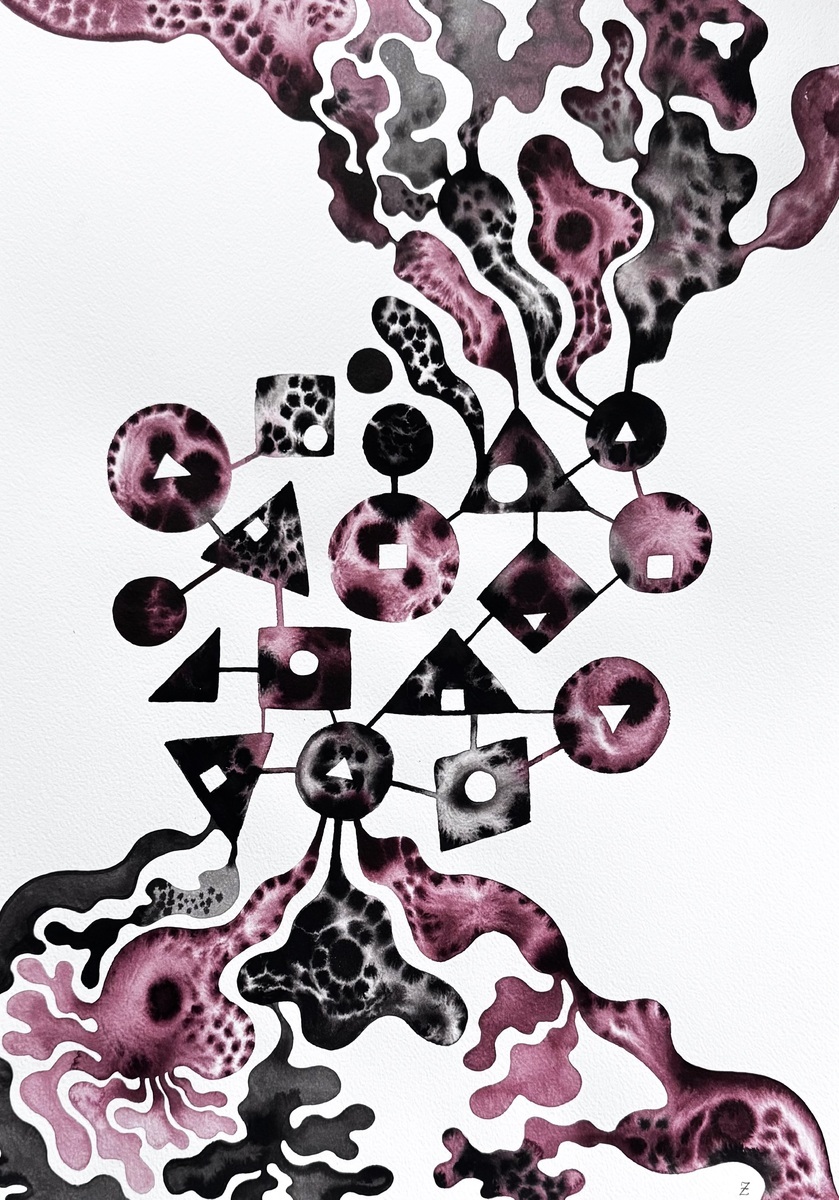
What Exactly Is Your Problem? An interview with Elif Zaim.
2026-10-21 – 2026-11-20
Elif Zaim releases ink into water, then asks the work.
An interview with Elif Zaim Conducted by: S. Çağatay Özkefeli
In Elif Zaim's works, it is often not the artist's hand but the ink finding its own path in water that has the final say. Following a journey from sociology to marketing communications and then to Traditional Turkish Arts, she brings together the measured pattern order of tile art and the unpredictable spread of ink on the same sheet of paper. In works such as Genealogy, Origin, and Alliance, the division of a cell and the dispersal of a family are narrated through the same signs. We spoke with Zaim at that threshold where surrender and liberation intersect, about how tradition is carried into the present and how a person can carve out their own quiet space in the midst of noise. The interview took place on the occasion of the exhibition Grammar of Chance, running at Collecist until December 28, 2026.
Surrendering control to water
S. Çağatay Özkefeli: In your works, it is often not your hand but the water and ink's own decision that is decisive. The moment when control ends and the material takes over — is that a surrender or a liberation for you? What does it feel like to stand at that threshold?
Elif Zaim: It is a liberation process in the fullest sense. One of the moments I love most and feel most at ease during production is when the ink disperses unpredictably in the water, revealing its own character. At that point, I feel no need to intervene in any way; on the contrary, I wait with excitement to see what possibility I will encounter. However, I do not think that determinacy and chance are completely separate from each other here. I determine the field of possibilities. I cannot control how the ink will behave, but I establish the space in which it will spread, the boundaries of the composition, and the relationships within the whole. So I am working on a possibility whose boundaries are defined. The question of the threshold is somewhat painful for me. Forming the composition, thinking through the possibilities, and establishing the right boundaries before releasing the ink into the water is quite an intense process. But once I cross that threshold, I experience great relief because I can already see the landscape I will encounter, and I begin to enjoy it.
From cell to kinship
S. Çağatay Özkefeli: Your journey from sociology to Traditional Turkish Arts is clearly readable in your works. In pieces such as Genealogy, Origin, and Alliance, we see biological forms and social bonds in the same breath. How did the idea of narrating the division of a cell and the dispersal of a family, a seed and an origin, through the same sign come about for you?
Elif Zaim: My artistic production process generally does not begin from a system of thought, a philosophy, a theory, or a specific event. I have a more impulsive, intuitive way of producing that serves as a kind of therapy for me. Most of the time I produce without trying to explain anything. When a work is complete, I place it in front of me and ask myself, "What exactly is your problem?" The answers I give afterwards form the intellectual framework of the work. For this reason, relationships such as cell, seed, origin, family, or social bonds are often not the starting point of production but rather the areas I discover after production. The fact that I completed an undergraduate degree in sociology, then a master's degree in marketing communications, and on top of that received training in Traditional Turkish Arts has, of course, had a very significant influence on these readings. Sociology and marketing communications taught me to read human relationships and social structures, while my art education taught me to think in terms of form, rhythm, repetition, and composition. I think these two fields speak to each other within my production language without my being aware of it.
Discipline and chaos at the same table
S. Çağatay Özkefeli: The traditional pattern order of tile art and the unpredictable spread of ink appear at first glance to be two mutually hostile worlds. You bring them together on the same sheet of paper. In this encounter, does one tame the other, or do they provoke each other and transform into something new?
Elif Zaim: They display an incredible harmony and get along very well. In fact, they know each other very well. The understanding of discipline, repetition, rhythm, and composition in Traditional Turkish arts essentially represents certain phenomena in my works. These patterns, which represent what does not change, form the boundaries and structures at a certain point, while the ink's unpredictable movement finds liberation within that structure. They both adapt to each other and open space for each other. Even contemporary or modern discourses cannot form without the traditional. Today's language comes from the past. The knowledge and accumulation of what is traditional continues to live on, transformed, within contemporary production.
Between microscope and telescope
S. Çağatay Özkefeli: There is a recurring "eye" or "seed" form in your works; sometimes a cell, sometimes a planet. What does the appearance of the same sign at both the most intimate and the most cosmic scale signify for you?
Elif Zaim: An important reason why these forms appear so intensively in my works is that I have been seriously influenced by Yayoi Kusama's production. The idea that everything begins with a dot, the visual world she constructs through punctuation and repetition, and the notion of reaching the cosmos also influenced my production language. But when you begin to use a form repeatedly, over time the meaning it carries for you also begins to change. These forms, which can be read as a dot, seed, or cell, can sometimes evoke a truly microscopic structure, sometimes a cosmic system, and sometimes simply a unit that creates rhythm within the composition. For me, this scalelessness is quite fascinating. The ability of the same visual sign to be read at different scales is a quality I pay attention to in my productions.
The courage to say "it's done"
S. Çağatay Özkefeli: In a production that works with chance, the moment of "completion" must be the most fragile decision. Do you sometimes look at a trace left by the water as a flaw and wish to correct it, or do you accept that flaw as the work's own decision? When, in your view, does a work complete itself?
Elif Zaim: This surrender is at the foundation of the works. That part of the production is so comfortable and easy for me that once the ink is released into the water, you really have very little chance of changing the outcome. So what remains is to wait with great excitement for the result that will emerge. At this point, what is truly decisive is how correct and satisfying the composition is. Sometimes it is possible to make small changes to the image that appears; but most of the time I place the finished work in front of me and observe it for a long time. The moment a work is truly complete for me is the moment when I look at it and no longer feel the need to add or change anything.
A quiet space in the age of noise
S. Çağatay Özkefeli: Being an artist producing in Turkey today means standing right at the intersection of a deep-rooted tradition and a rapidly digitalizing world. Within this abundance of images and content, what value do you think independent art spaces like Collecist hold? How do you envision the future of art and the artist in this "age of noise" — in whose hands and in what form will this future be shaped?
Elif Zaim: All the social changes taking place are quite entertaining and acceptable to me. In fact, one of the processes I follow with the most excitement is observing how society and modes of production are transforming. For this reason, I do not see the noisiness of the age as a problem in itself. What matters is being able to choose what to listen to within that noise. I think digitalization has also brought about an important transformation in terms of art. We are in a period when art is no longer confined to physical galleries and exhibition spaces, and when the distance between the artist and the viewer and collector is being redefined. I see this transformation not merely as a necessity but as an important opportunity for art to discover new modes of expression and sharing. I find Collecist valuable at this point. Because it does not only create a space where works are exhibited digitally; it opens a more direct space for the artist to convey their production, text, and context. Particularly its support for establishing a direct relationship between artist and collector, going beyond the boundaries of physical galleries, is an important approach in terms of independent art production. For artists producing from Turkey, the provision of international visibility through such a space is also separately precious. The ability of an artist to reach not only their work but also their mode of production and intellectual world to audiences in different geographies is, I think, one of the strongest aspects of the digital art space. As for the future, I do not foresee a single model. I believe art, like society, will continue to transform constantly. My approach is to accept the changes taking place as they are, to observe them, and to use them as correctly as possible. We do not need to turn down the volume of the age; we need to learn to turn down our own volume when necessary, to step back, and to create a quiet space of our own. I think independent platforms like Collecist can also take on an important role in this new art ecosystem. As long as we can see the physical and the digital not as alternatives to each other but as spaces that complement each other, I believe the space that art can reach will continue to expand.
Interview: S. Çağatay Özkefeli Curator · Collecist