
Art doesn't owe you dopamine, it owes you meaning.
A new book has come out. Scientist Daisy Fancourt, in her work called Healing with Art, says that art lowers blood pressure, increases neuroplasticity and extends life expectancy. It prevents suicides, stops epidemics. Like consuming five portions of fruit and vegetables a day but perhaps something more refined: exhibition opening, dance workshop, music therapy. Research has also shown that those who "interact" with art more frequently behave more healthily.
At this point, one needs to take a step back.
In ancient Greece, art was not a therapeutic tool. Aristotle's concept of catharsis proposed that tragedy provided a kind of purification by arousing feelings of fear and pity in the audience but this was not a process designed to improve the audience's blood pressure values. Sophocles' Antigone did not comfort people; it tore them apart. And there was a purpose in this: to force humans to look at the fragile contradictions within their own existence.
Art has existed as a form of communication since its origins. Sometimes a speaker, sometimes a novel narrator, sometimes an interpreter, ethicist, semiotician. Mike Kelley says he uses psychological theories only for "poetic purposes." He loves Freud not as a scientific authority, but as a writer because art exists not to prove theories, but to hold them under a light and make them tremble. When examining the matter of sublimation, he actually speaks of metaphor: the idea that one thing can stand in place of another. This is identical with art itself.
So what is happening today?
When looking at the current art environment, it appears that production is drowning in two separate crises. On one side there is what Fancourt's book symbolizes: an approach that reduces art to individual welfare enhancement, dopamine release, "healthy behavior change." In this view, art loses its own reason for existence now it serves something, supports something, heals something. It needs to have a justification to exist.
.png)
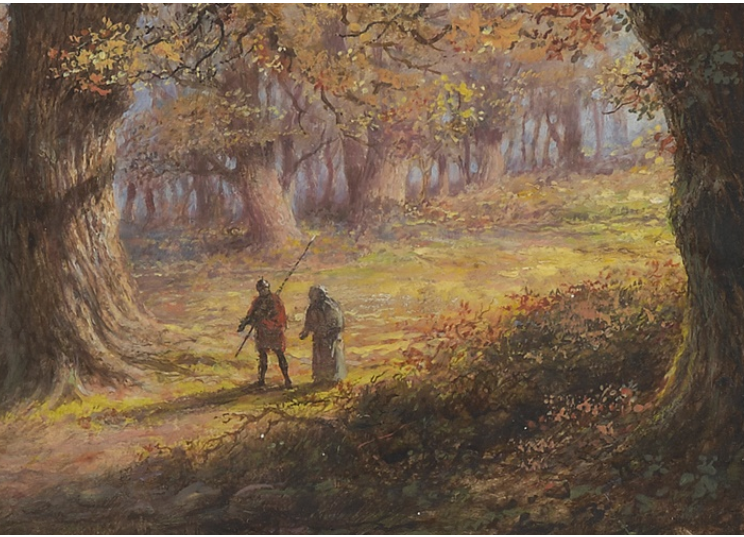
JAMES NASMYTH (SCOTTISH 1808-1890)
On the other side there is the flood of low altitude created by social media. Instagram and TikTok are transforming art into content within an endless cycle of visual consumption. Rapid production, instant visibility, like metrics. Umberto Eco's observation about the work becoming independent from the artist works in reverse here: the work is now also becoming independent from the viewer flowing by without a real encounter taking place.
As Martin Herbert says: ninety percent of every generation's art is probably mediocre. This has always been the case. The problem is not the existence of mediocrity; it's that the excessive production practice that removes conceptual questions from the agenda blocks the way for works that ask questions. When we say "every generation creates its own world," it also creates its own blind spots. Today's blind spot is this: when art has shifted from producing meaning to producing content, and when it is additionally presented as a health tool, an extremely innocent-looking but extremely dangerous emptying emerges.
Why does art exist? To ask this is equivalent to asking about existence itself. The human's search for meaning in their own inner world anxiety, mortality, the reality of the other these are the raw materials of art. What matters is not terminology, but the conflict that terminology creates. Art is conflict itself. It is what shocks, disturbs, turns categories upside down.
Fancourt's good intentions cannot be denied. It is true to say that an isolated, overworked, joyless life is harmful in every way. It is also true that the connection established with art gives people a sense of agency. But to trap this in a health/illness paradigm is to reduce what is a moral and political necessity that is, the right to touch human's world of meaning to biochemistry.
Art doesn't owe you dopamine. It owes meaning.
And meaning always comes a bit disturbing.