
Everything Is in Its Place. Applause was measured, the question was not.

At an exhibition opening, everything is in its place. Artists, curators, collectors, guests. Works on the walls, a carefully written text at the entrance. Within that text, the full weight of the age circulates: memory, identity, belonging, fragility, ecology, migration, the body, borders, and of course the unseen. Every sentence makes us feel as though we stand at the threshold of a truth.
Then we begin to walk through the exhibition.
Sometimes the depth promised by the text finds an unexpected response among the works. An object, a void, an almost imperceptible touch establishes in a few seconds the connection that pages of explanation could not. And sometimes the thought that grows in the text shrinks in the gallery; the works seem more occupied with carrying the meaning loaded onto them than with their own existence.
What is interesting is this: in both cases, the opening closes with the same sense of success. Yet the success of art and the success of an art event are not the same thing.
The years it first reached our ears
The late 1980s, the early 1990s. I was a student of fine arts and the word "postmodernism" was just beginning to reach our ears. In Turkey it had not yet become part of everyday art vocabulary; there were few translations, many debates. Concepts were not easily consumed. What a work avoided saying was as discussable as what it said.
Even meaninglessness was sometimes a meaningful proposition. When finishing school, at an exhibition I had hung a plumb line and crossed out an illegible print proof. No one could say in a single sentence what it meant; but everyone could ask why it stood that way. Ambiguity did not relieve the artist of responsibility — on the contrary, it made that responsibility more visible.
It would be misleading to call these years a golden age. Art circles back then also produced their own hierarchies, exclusionary language, and financial relationships. But there was one thing: an artist's word could be criticized independently of their reputation. A thought being impressive did not mean its artistic realization was considered sufficient. Criticism was not a verdict but a way of participating in production.
When circulation becomes the measure
What has changed is perhaps precisely the nature of this relationship. Digitalization expanded the circulation of art to an unprecedented degree. An artist can now show their work without waiting at the door of a gallery; distances lose their significance. These are not gains to be dismissed. Collecist was born from exactly this opening of the door.
But as visibility became easier, another measure grew stronger: circulation itself. How many people an exhibition reached, under which institution's roof it opened, by whom it was shared — sometimes this overtakes the question of what it actually achieved.
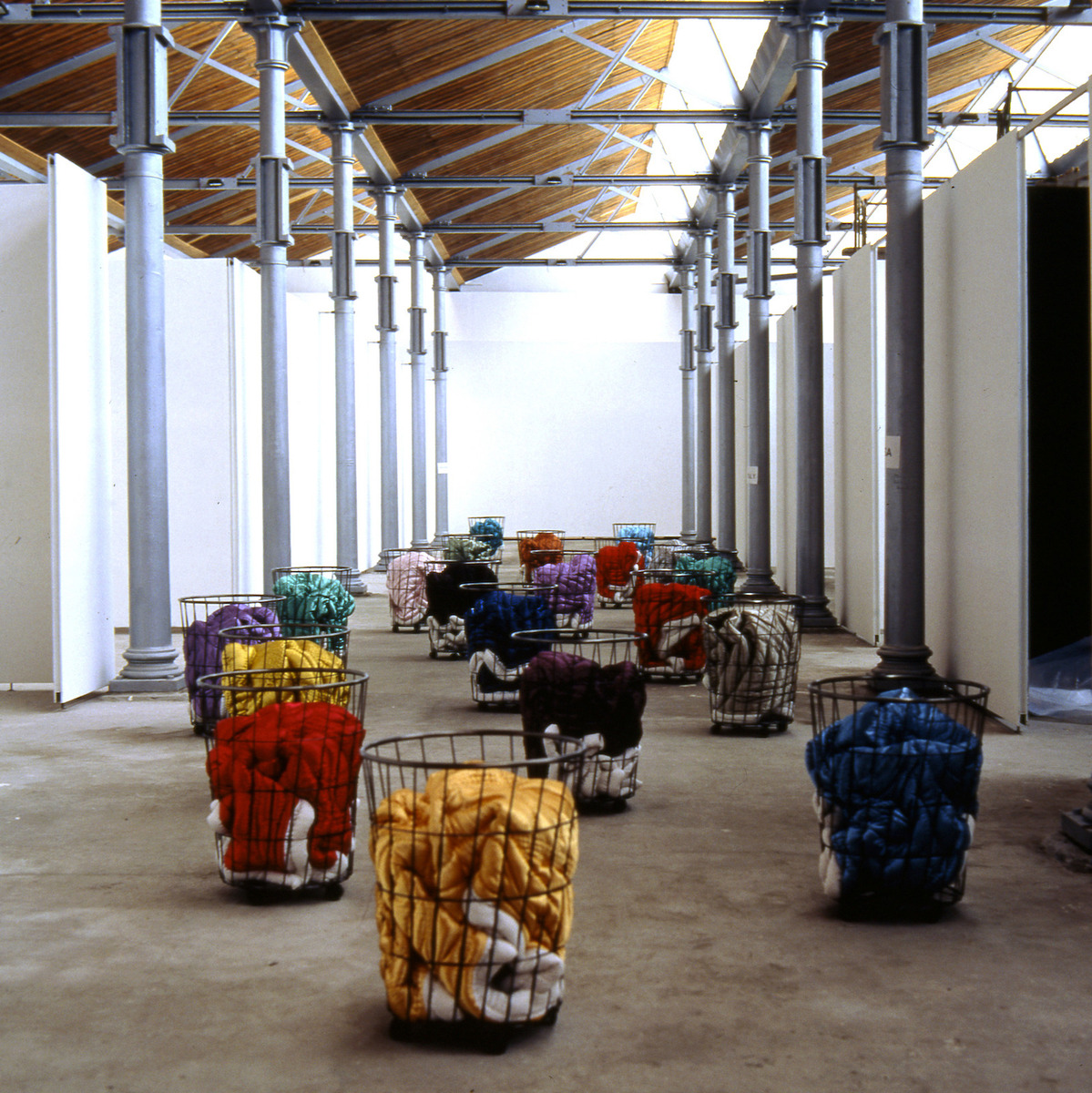
A recent example: the first leg of the 18th Istanbul Biennial, free of charge, welcomed over 600,000 visitors in ten weeks. During a brief trip to Istanbul at that time I tried to visit once myself; the queue was so long I could not get in. The crowds were heartening — art reaching a broad audience is always good news. Then the structure, designed to unfold over three years, closed at its first leg when the curator departed for personal reasons. What largely remained in public memory were two things: the visitor count and the news of its premature end. The conversation about what the works actually said remained thin. One coincidence is also worth noting: the main venue of the 19th Biennial in 2027 is Feshane. The same building had been opened to art in 1992 with a biennial themed around "cultural difference" — one of the first great waves of postmodern discourse to reach this city. Thirty-five years later, a return to the same walls. Let us hope the question returns as well.
When the text steps in front of the work
It would be simplistic to accuse curatorship of intellectual inadequacy. Many of today's curatorial approaches are nuanced, research-based, and sensitive to the complexity of the age. But the same intellectual competence does not always give rise to an equally powerful artistic act. Even when the theoretical framework is internally coherent, the exhibition may fail to translate that coherence into a sensory experience. At that point the text takes on the meanings the works have not yet managed to realize, rather than explaining them.
The thought does not arise from the work; it hovers over it.
This distance is not always failure. A strong work can contradict the text written to explain it; it can produce a meaning the curator did not anticipate. The problem is not the gap itself, but the fact that this gap is counted as success without ever being questioned.
Exhibitions depend on money, space, and support. These are not dirty things standing outside of art — they are the material conditions of production. But sometimes the safe boundaries of these conditions also draw the limits of where intellectual ambition can reach. It is possible to construct a radical statement within a field whose limits are set in advance; what is difficult is genuinely assuming the risk that statement demands. And so a language that questions the order can fit perfectly into that same order. Even dissent can become an item on a promotional plan.
The viewer's right
A viewer unfamiliar with the language of contemporary art may look for the fault within themselves when a work leaves them unmoved. Yet feeling nothing in front of a work is itself an experience worth speaking about. Not every silence arises from the viewer's deficiency. Sometimes the work has genuinely failed to establish a connection; sometimes the time, context, or attention required for that connection has simply not yet formed.
Art being open to everyone does not require every work to be easily understood. But it also does not permit incomprehensibility to be taken as superiority in and of itself.
A note from Collecist
We are writing this from within a commission-free digital platform — which means we are not outside this circulation economy. We too produce visibility, we too look at share counts. That is why we ask ourselves the same question: when we place a work in the window, are we amplifying what it says, or merely raising its volume?
What we believe is needed is not for art to speak more simply, but for it to be willing to put its own words to the test. A space in which the respect felt for an artist, curator, or institution does not shield the work from criticism, and success is not measured by crowds alone. It will not be more exhibitions, larger institutions, or wider access alone that determines the future of art. The honest relationship art maintains with its own claims will also be a determining factor.
In exhibitions that speak of a world where everything can be questioned, sometimes the one thing left unquestioned is the exhibition itself.
The opening ends. Speeches are made, photographs are shared, thanks are given. Preparations for the next exhibition begin.
Everything is in its place.
Only the question of what the work has truly said to us waits a little longer in the queue.
Collecist — The Silent Space of Art
Photograph:
Gülsün Karamustafa, "Mystical Transport", 3rd International Istanbul Biennial (Istanbul Metropolitan Municipality Nejat F. Eczacıbaşı Museum of Art, Feshane), 1992 Courtesy of the artist.