
Fur Chrome
An eight-hundred-year class journey of a dog.
Once upon a time, there were small, furry dogs standing at the feet of aristocrats. Today, stainless steel balloon dogs rise in collectors' salons. At first glance, there seems to be no connection between these two images: one is a living being breathing in the depth of oil painting, the other is the cold gleam of an industrial surface. Yet art history tells us something different.
Images do not die. They only change class.
This essay will attempt to trace the silent kinship between two seemingly distant dog figures. Because whether we are truly creating new images, or whether old desires are merely donning new surfaces, the answer to this question is more decisive than we think for understanding the relationship contemporary art establishes with the market.
German art historian Aby Warburg, at the beginning of the twentieth century, put forth the concept of Nachleben der Bilder the survival of images after death. According to Warburg, images appear to have vanished at certain points in history, then return in another era, in another context, often in an unrecognizable costume. The wing movement of a Renaissance angel can be inherited from the ecstasy of an ancient bacchant; a female body in an advertisement can unknowingly carry the iconography of a Venus from four hundred years ago. Images do not sleep in the archive; they are in circulation.
Pierre Bourdieu approaches the matter from a different angle. According to him, taste is not innocent. Which painting we look at, which artist we hang on our wall, which work we find "meaningful" — all of these are organized within the secret economy of cultural capital. The image is not merely an aesthetic object, but also a technology of power. What one says they love also reveals where that person stands in the world.
When Warburg and Bourdieu are brought together, we are left with this: Images both circulate through time and take class positions. The story of a dog may be one of the most silent, most overlooked examples of this.
The Dog at the Noble's Feet — The Silent Language of Status
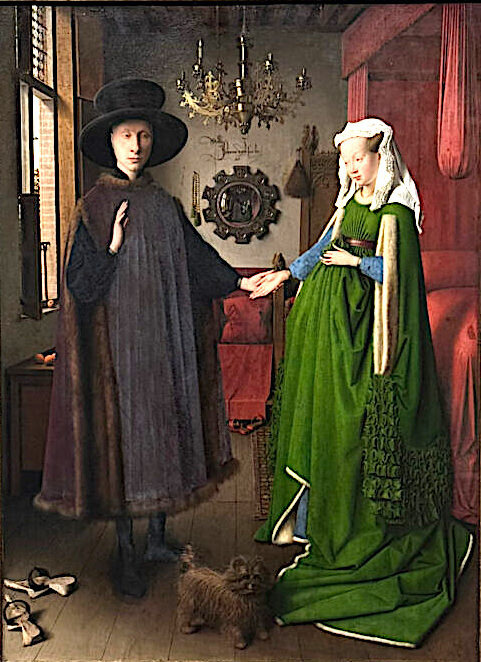
Look carefully at Jan van Eyck's 1434 Arnolfini Portrait. Right in the center of the merchant couple, at the lowest layer of the composition, stands a small furry dog. Some art historians connect it to the fidelity of marriage; some, to a promise regarding the continuity of lineage. But there is another invisible reason for the dog to be there: Arnolfini's ability to afford to feed it.
The small lapdog that repeatedly appears in aristocratic portraits — in the laps of Veronese's Venetian women, beside Velázquez's Spanish princesses, in the corners of eighteenth-century English portraits — is not merely a pet. These dogs are unemployed. They don't hunt game, they don't herd flocks, they don't guard. They have one job: to be looked at. And precisely this unemployment transforms them into status symbols.
For a class that doesn't have to work to be able to carry an animal that doesn't have to work — this is an economic luxury. A dog's fur being combed for days, being fed specially, servants attending to it; all this invisible labor says one thing:
No one in this house needs to work.
Hunting dogs are of a different vein: power, ownership, dominion over land. A greyhound beside a nobleman says that he has the right to hunt — meaning he is a landowner. The peasant's hunting was forbidden; the nobleman's was almost ceremonial. The dog here is not an animal, but a living symbol of a legal privilege.
Nobles did not have their dogs painted because they loved them. The dog made their place in the world visible.
Shedding Fur — Modernity's Corruption of the Image
The nineteenth century shattered this silent language. The rise of the bourgeoisie, the invention of photography, mass production — the aristocratic representation mechanism was beginning to crack. The portrait fell from the noble's monopoly to the merchant's salon, then to the photographer's studio. The image seemed to be democratizing.
But was it really?
By the middle of the twentieth century, Andy Warhol discovered the new logic of status imagery: Marilyn's face, Campbell's soup can, dollar sign. Warhol's mass-produced icons seem like the opposite of aristocratic portraiture not unique, but multiplied; not handmade, but mechanical; not noble, but popular. Yet the irony is this: Warhol's Marilyns are today among the world's most expensive artworks. Reproducibility did not eliminate scarcity; it only changed the definition of scarcity.
Takashi Murakami took this logic one step further. Superflat aesthetics, anime, Louis Vuitton collaborations melted the boundary between high and low culture. Murakami's colorful flowers carry the joy of a children's cartoon; but owning a Murakami means accessing not childlike joy, but a very special cultural position.
Modernity did not de-ennoble the image. It only redefined aristocracy.
The New Aristocrat's Dog — Jeff Koons
And then Koons came.
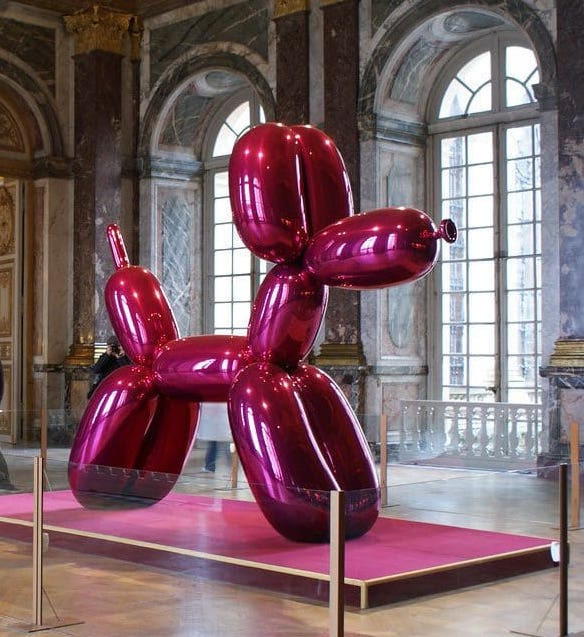
The Balloon Dog series that began in 1994 orange, blue, red, yellow, magenta became one of contemporary art's most recognizable icons. In 2013, the orange one sold at Christie's for $58.4 million; it was the most expensive work by a living artist sold at auction at that time. An object that seemed to have emerged from a child's birthday party had become one of the world's most expensive contemporary sculptures.
How was this possible?
The answer lies in the paradoxical engineering beneath Koons's work's playful surface: Balloon Dog looks like a toy but is expensive. It looks light but is stainless steel, weighing approximately one ton. It carries childhood sentiment but is an elite capital object. It transforms a temporary object — a carnival balloon — into a permanent monument. It converts the cheap to expensive, the kitsch to high art, the temporary to investment.
Let's recall Guy Debord's Society of the Spectacle: In late capitalism, the commodity no longer merely carries use value; it becomes spectacle, circulates, gains value by being visible. Balloon Dog is exactly this — sculpture as spectacle. It is visible at museum scale, produces photographs, perfectly adapts to social media circulation, transforms the space it occupies into a prestige field, and ultimately is a financial investment object.
The claim is this: Koons did not create a new image. He updated the aristocratic representation mechanism.
Even the material tells this story: The privilege once represented by fur today shines on a chrome surface.
The dog remains in place. It has only shed its fur, replaced by an industrial polish.
What Does the Collector Buy?
Here we must come to the art world's most uncomfortable question: Does the collector buy art, or cultural status?
The answer is probably both, and the ratio — to speak honestly — is often hard to determine. But if we look at the mechanism, the clues are not hidden. Art Basel's VIP opening begins days before the exhibition opens to the public; there, purchasing decisions are made by people who haven't yet seen the works, by phone, from waiting lists. Record sales at auctions make headlines on news sites, because price is now part of the work perhaps its most visible part. The "blue-chip" artist economy is based on a silent consensus about which names won't lose value; access to this consensus is itself a form of capital.
As Bourdieu said: Taste is not innocent. What we buy announces who we are or more accurately, who we want to be. While the language of this announcement was once fur, coats of arms and portraits; today it is blue-chip artists, auction results, biennial circuits and works carrying investment value.
Yesterday nobles wrote themselves into history by commissioning portraits. Today collectors may be doing this through the art market. The mechanism is the same: becoming visible through an object, differentiating oneself, feeling that one stands on the chosen side of history.
A parenthesis needs to be opened here. This essay does not blame artists, nor does it devalue the act of collecting. A large part of art history would not have reached today without the patronage tradition. The issue is not individuals, but the mechanism itself — and which images that mechanism makes visible for whom. If art will always circulate as new costumes for the same status game, the question remains: Is an image possible outside this cycle?
Conclusion — Images Don't Die, They Shed Fur
Perhaps art history is not the history of new images. Perhaps it is only the story of old desires constantly changing costumes.
Warburg was right: Images do not die, they only reawaken in another age, on another surface. If the furry dog standing on the palace carpet appears before us today as a stainless steel balloon in a white cube gallery, what has changed is not only the material. What has changed is the identity of the class that wants to be visible; what remains unchanged is the desire to be visible itself.
Humans still want the same thing: to be seen, to differentiate, and to make their place in the world visible. This desire is not bad in itself — perhaps this is one of all art's veins. But when this vein stands alone, art history turns into merely a status exchange ledger. What remains to be asked is this: Which images try to break out of this cycle? Which ones are merely shedding fur, which ones are truly looking elsewhere?
Because images do not die.They only shed fur.