
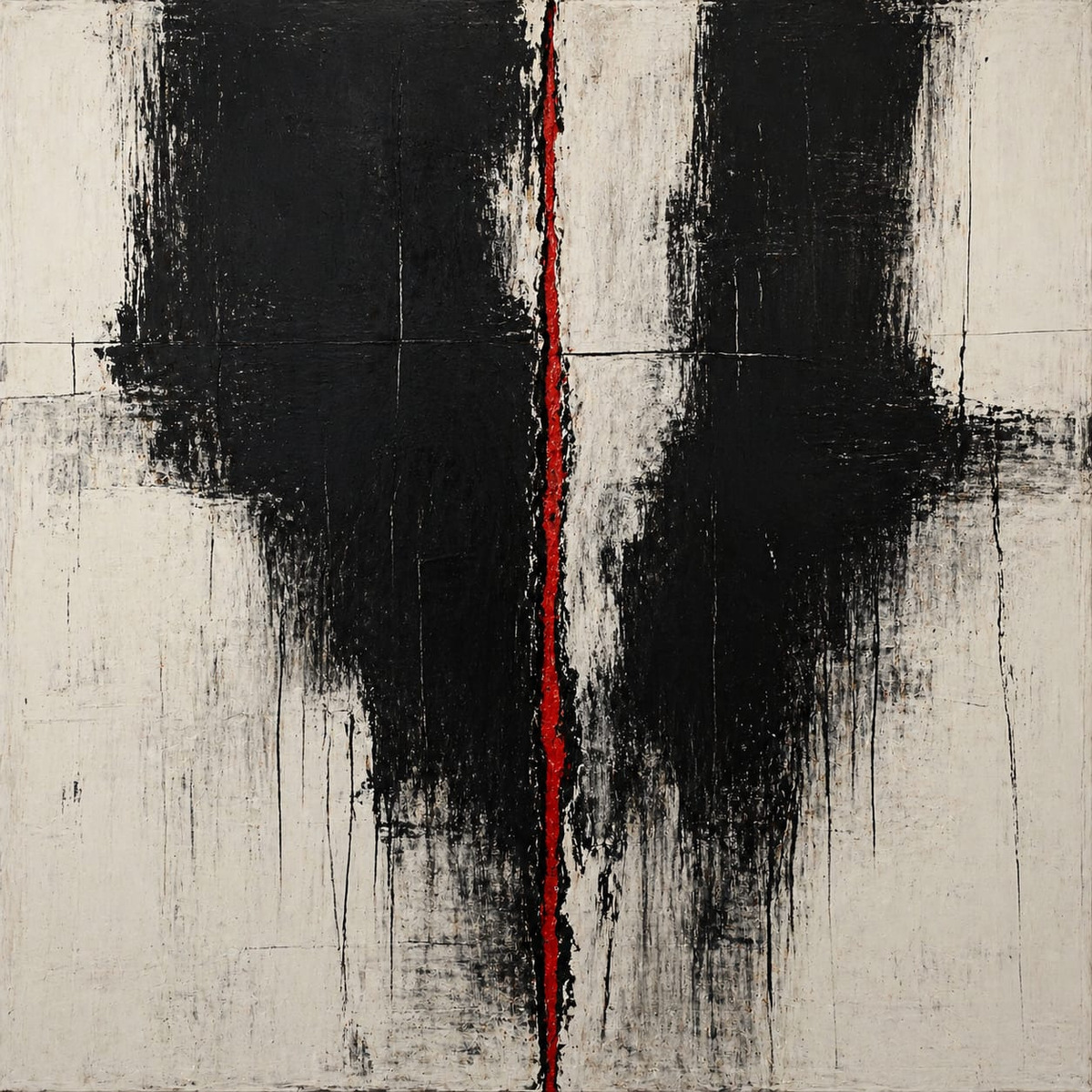
Possibility
Possibility
Why can no one else
ever dwell
in the artist's ego?
There is always a strange tremor in one artist's gaze upon another. Admiration, jealousy, curiosity - often all of these live simultaneously within the same look. And calling this tremor "jealousy" leaves it incomplete, because what happens here is something more definite: the artist does not envy another artist. They envy the possibility of being replaced. This distinction may seem small, but it changes everything. Jealousy is an emotion, possibility is an existential threat. And faced with this threat, the ego produces very different reactions - often production, sometimes violence, sometimes both at once.
The ego needs a mirror to define itself. Another artist is the closest and most dangerous version of that mirror because they work with similar material, similar claims. But the mirror is dangerous because it reflects wrongly. The reflection that a great artist's ego expects is clear: I am here, I am central, my style is the form that art can take. Another artist disrupts this reflection. They too have a style, they too have claims, they too have an audience. And the most unbearable thing: perhaps tomorrow, their work will replace yours. This concrete possibility is the ego's real enemy.
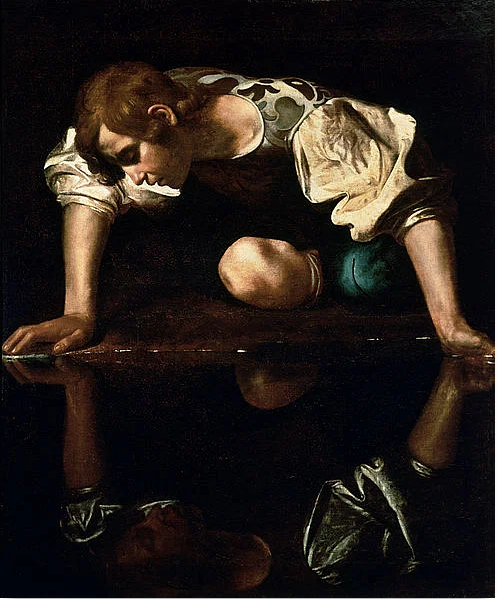
Caravaggio's oil painting from the 16th century AD, depicting the handsome young Narcissus from Greek mythology falling in love with his own reflection. (Galleria Nazionale d'Arte Antica, Rome)
The artist does not envy another artist. They envy the possibility of being replaced.
History is full of artists who struggled to live with this possibility. Michelangelo openly humiliated Leonardo in front of a crowd the pretext was an unfinished horse sculpture, but the real issue wasn't technical. Leonardo's existence didn't fit into Michelangelo's claim to universality. Two geniuses breathing simultaneously in the same city was an ontological problem for both. The conflict between Ingres and Delacroix can be read the same way: Ingres blocked Delacroix's membership to the French Academy for years. What he did wasn't an aesthetic debate, but using institutional power to restrict his rival's possibility of replacement. When he said "You use color wrongly," what he was actually saying was: "You have no place here."
Arles, 1888. Gauguin and Van Gogh shared the same house for eight weeks. Gauguin found Van Gogh crude and chaotic; he was both impressed and disturbed by that intensity. It's possible to read this in his discomfort: Gauguin saw something in Van Gogh's energy that he himself lacked and didn't want to see. The possibility was there, inside the house, every day. Gauguin left the house before Van Gogh cut off his ear. Being unable to bear the possibility of someone else's replacement sometimes results in physical escape.
The harshest competitions gave birth to the strongest works - when possibility becomes a nightmare, the ego produces harder to prove itself.
And here a dark paradox comes into play. Picasso and Matisse produced to destroy each other for decades; what one did provoked the other, that provocation turned into a new work, that work provoked again. The eight weeks of Gauguin and Van Gogh that ended in disaster was a period when both produced their most extraordinary works. When possibility becomes pressure, the ego responds to this pressure with production. To prove that they cannot be replaced, they work harder, further, more uniquely. This is why reading the tension between artists as mere hatred is wrong - there's a strange productivity in it, an urgent energy created by possibility.
Psychology tried to explain this dynamic with different frameworks. René Girard's mimetic desire theory says this: People learn what they should desire from others. The artist also learns what's possible partly by looking at other artists. But then this model becomes both guide and rival - desiring the same field means sharing the same field. Hegel's dialectic of recognition opens another door: Consciousness can only establish itself by being recognized by another consciousness. For the artist, this recognition is both necessary and impossible they want their rival to recognize them, but they cannot accept their rival's existence as an equivalent subject. Because what is equivalent can also replace.
Historically, these conflicts were embodied around patronage - who would paint the church wall, who would receive the Academy's grand prize. Today the structure is the same, the stage has changed: galleries, biennials, museum acquisition committees. Who will be included in which fair, whose work will enter which collection - these are contemporary versions of the possibility of replacement. In Hasan Bülant Kahraman's writings on contemporary art, this structure can be read in the Turkish context as well: in small markets, possibility is much more concrete, much closer. The same gallery, the same collector, the same institution - the rival here is not abstract, but someone with a known name.
Saying "most art is bad" might be correct. But the one saying this is actually talking about possibility, about the possibility of someone else's replacement.
In 1998, Coagula magazine published a compilation titled "Most Art Sucks." A critic evaluating that period years later said this: The vast majority of art produced at any point in history is mediocre and as long as you expect this, it's not a problem; the real job is to find and defend the minority. But the sentence "most art is bad" says no less about its speaker than what it says. When young, that critic found contemporary art exciting. Then generations changed, new artists emerged, he was marginalized. And he saw that everything seemed meaningless. The only thing that changed was the coordinates, but the shift of coordinates, the materialization of new names' possibility of replacement, is unacceptable to the ego. The word "bad" is the fastest way to ward off this possibility.
At the end of 2024, Dean Kissick said in Harper's Magazine "How Politics Destroyed Contemporary Art." He argued that art had lost its beauty and strange spirit. The argument has a certain appeal - the transformation of political language into an institutional reflex is an observable phenomenon. But Kissick's blind spot is this: the "beauty" and "strangeness" he longs for contain pre-given answers about which art opens this door. Guernica is powerful both politically and aesthetically. David Hammons's works are both loaded with identity politics and genuinely strange. Kissick's complaint is actually not about art, but about the change of the art he's accustomed to. In other words: about a new possibility having infiltrated his world.
When I think of my own work as an editor in this context, I reach a disturbing clarity: choosing which text to publish, which to leave out - these choices are also within the question of possibility. Which artist's voice will come forward, which framework will be used, whose perspective will be centered. An objective editorial judgment is not possible. But what can be done is to make one's own position transparent and to genuinely and curiously challenge the things framed by one's own perspective - to learn to work with possibility instead of suppressing it.
Realizing that something other than yourself is real, all art begins from there.
Iris Murdoch has a sentence: The thing that is really hard to realize is that "something other than yourself is real." Art is the discovery of this reality. And an artist's gaze upon another artist is the most intense, most dangerous form of this discovery because what is encountered there is not an abstract otherness, but a concrete, productive, visible possibility that directly challenges your own claims. The ego cannot love this. But sometimes, precisely in this moment of not being able to love, the most powerful works are born. Michelangelo had to understand Leonardo first in order to be able to belittle him. Understanding, however much it is desired, means opening up some space for that possibility.
The tension between artists is therefore never pure hatred. It carries within it a hidden recognition, a neediness, sometimes unbearable admiration. Possibility is the artist's greatest nightmare. And their most necessary fuel.
Sources
Iris Murdoch, Existentialists and Mystics: Writings on Philosophy and Literature, ed. Peter J. Conradi, Allen Lane, 1998.
René Girard, Deceit, Desire and the Novel, Johns Hopkins University Press, 1965.
G.W.F. Hegel, Phenomenology of Spirit, 1807.
Hasan Bülent Kahraman, What's the State of Art Today, Agora Library. Basic source for Turkey contemporary art market and postmodernism discussions.
Dean Kissick, 'The Painted Protest', Harper's Magazine, December 2024. Martin Herbert, 'Can You Age Out of the Art World?', ArtReview, November 2024.
This text is editorial content prepared for the ArtSahne / Collecist editorial framework.