
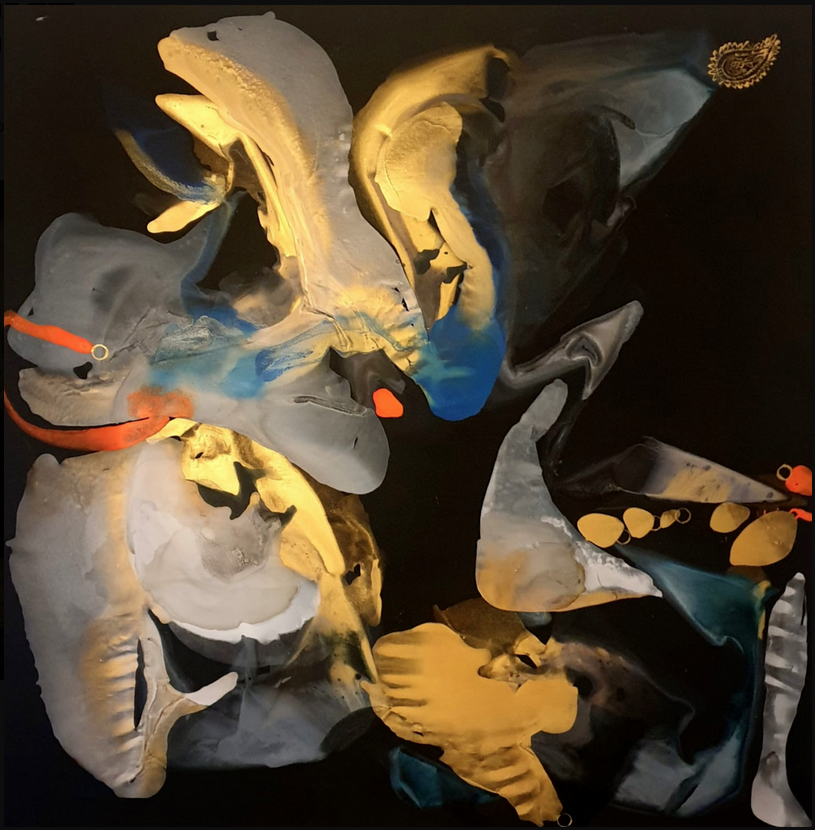
Abstract Art: The Map of the Invisible and the Fictional Architecture of the Mind - Prof.Gülten İmamoğlu
2026-03-01 – 2026-03-31
Abstract Art: The Map of the Invisible and the Fictional Architecture of the Mind
Abstract art is not a conscious break from the representation of the visible world; on the contrary, it is an attempt to reveal the structural, emotional and existential layers behind it. By transcending the boundaries of the figurative, this approach shaped in the artist's mental and intuitive realm is not only an aesthetic choice, but also an ontological inquiry. In this context, abstract art centers the questions "how do we perceive?" and "what do we feel?" rather than the question "what do we see?"
Abstract art, which emerged at the beginning of the 20th century, can be read as a kind of resistance and reconstruction practice against the accelerating reality of modernity. With the dissolution of representation, art ceases to be an imitation of the external world and begins to produce its own language and its own reality. At this point, the artist is not only an observer; but also a founder, a system designer and an architect of thought.
It is possible to trace this rupture back to Immanuel Kant's distinction between "the thing in itself" and "the perceived." As Kant pointed out, the world appears to us not as it is, but through the way our mind processes it. The abstract artist works precisely at this threshold: in the gap between the visible and the perceived. This gap is where representation dissolves and a new language is established.
But here a critical question arises: How does the abstract artist perceive the external world? This perception is not limited to the processing of visual data alone. From a neuroscientific perspective, in the mind of the abstract artist, there is not a sharp distinction between the right and left hemispheres of the brain, but rather a continuous transitivity and interaction. The left hemisphere associated with analytical, discriminating and linguistic functions and the right hemisphere governing holistic, intuitive and relational perception work simultaneously and transformatively in the production process. This situation enables the artist to both establish structure and sense the flow within that structure.
When the abstract artist looks at the external world, he does not perceive objects within fixed and defined categories as most people do. A tree, a building or a human figure; gains meaning for him primarily not by "what it is" but by "how it appears" and "how it makes one feel." Light refractions on surfaces, color transitions, rhythmic repetitions and voids become more decisive than the object itself. For this reason, the abstract artist's perception is not descriptive; it is a transformative perception. The external world is reconstructed in the mind by decomposing into its potential forms, not as it is.
This approach also overlaps with Henri Bergson's concept of intuition. According to Bergson, reality is grasped in continuity and flow rather than static objects. The abstract artist's perception of the external world is also directed towards this flow. What is seen is not a frozen image; it is a network of relationships that constantly change in continuity.
The production process of the abstract artist is often not linear. On the contrary, it has a recursive, layered and experimental structure. The first gesture or the first stain is often only a starting point of the final result. From this point on, the artist establishes a kind of dialogue with the work. Each intervention both covers and transforms the previous layer. This process also overlaps with Martin Heidegger's definition of the work of art as a realm of "disclosure." The work here is not only something made; it is also a process that opens itself and gains existence.
The surface that emerges in this production practice is not only an aesthetic realm; it is also a map of thought. Colors, lines and stains; come together to create not only a visual whole, but also a flow of energy, a rhythm and a sense of direction. At this point, Wassily Kandinsky's concept of "inner necessity" becomes decisive. According to Kandinsky, the work of art is a result of the artist's inner vibrations, not the external world.
In this respect, abstract art establishes a connection between individual experience and a broader sense of existence. When the viewer looks at the work, he does not only see a composition; he also confronts his own way of perception. This encounter can also be associated with Maurice Merleau-Ponty's theory of embodied perception. According to him, seeing is not a passive action; it is an active relationship that the body establishes with the world. Abstract art makes this relationship visible.
From a psychological perspective, abstract art plays an important role in making unconscious processes visible. At this point, Carl Gustav Jung's concept of collective unconscious comes into play. Abstract forms often go beyond individual experience to produce archetypal images.
In economic and sociological context, abstract art is one of the most controversial but also most effective areas of the art market. This field, where value is determined not by objective criteria but more by contextual, historical and conceptual references, when considered together with Theodor W. Adorno's critiques of culture industry, makes visible the nature of art that both resists and is included in the system.
In conclusion, abstract art is not only an art form; it is a way of thinking, a regime of perception and a practice of existence. While making the invisible visible, it also reminds us how limited the visible is. The abstract artist does not convey the external world as it is; but establishes a mental structure that dissolves, transforms and reconstructs it. For this reason, abstract art does not offer definitive answers; but it teaches us to ask the right questions. And perhaps most importantly, it invites the viewer not only to look, but to truly see.
Prof.Gülten İmamoğlu