


Talking Alongside; Fragile Rhythm
SPEAKING ALONGSIDE; FRAGILE RITUALS
The Politics of Silence Through Time, Space and Body
In an era where the boundaries between cinema and contemporary art practice are blurred, three artists from different generations and geographies—Ira Sachs, Béla Tarr and Karimah Ashadu—form a common line of aesthetic resistance: making the ordinary moments of everyday life monumental, making the invisible visible, and using temporality itself as a political tool against the narrative economy imposed by speed. Although these three names work within different mediums and contexts, they position silence, waiting and observation as a radical stance against dominant narrative structures. Sachs's micro-universes built on queer intimacy, human conditions dissolving within Tarr's apocalyptic slowness, and Ashadu's negotiation between body and space in postcolonial Lagos all ask the same question in different tones: In a world hastily produced, consumed and forgotten, what kind of agency does stopping and looking carry?
Ira Sachs's cinema combines the political stance of queer cinema with the intimate power of melodrama, showing how the private sphere transforms into an ideological battlefield within itself. In films like "Passages" and "Frankie," the emotional geopolitics between characters reveals how space—whether a Parisian apartment, a summer house in Portugal —shapes and limits characters' desires. As Sachs recodes John Cassavetes's improvisational intimacy understanding with a queer sensibility, he rejects the "solution" and "closure" mechanisms imposed by heteronormative narrative structures. His characters don't resolve, they simply exist with their uncertainties, contradictions, endless negotiations. This is a cinema that breaks the cause-effect chain of classical Hollywood dramaturgy, instead offering the simultaneity of emotional states. Sachs's camera movement, while following characters' bodies, never places them in a position of power; instead, it records their fragilities, vulnerabilities, the inconsistency of their desires. This is the fundamental politics of queer cinema: accepting the state of constantly returning, renegotiating, never quite settling instead of the "development arc" of normative narrative.
With Béla Tarr's death, cinema lost one of its rare masters who used slowness as an ontological stance rather than merely an aesthetic choice. Tarr's films "Satantango," "The Turin Horse," "Werckmeister Harmonies" transform the flow of time so profoundly that the viewing experience becomes almost a meditative process for the spectator. However, this slowness stems not from contemplative luxury but from existential necessity. Tarr's people buried in mud in the Hungarian countryside, figures waiting under endless rain, move within a cyclical temporality where the myth of historical progress has completely collapsed. Tarr converts Andrei Tarkovsky's spiritual transcendence into earthly materialism; his characters don't wait to be saved, they simply endure. His long sequence-shots transform observation from a passive activity to active participation, giving the audience the responsibility of sharing the act of "waiting" with the characters. This is one of the most radical resistances against cinema's capitalist consumption logic fast cuts, information bombardment, emotional manipulation. Tarr's aesthetics resonate with Theodore Adorno's concept of "negative dialectics": negating instead of affirming, sustaining contradiction instead of synthesis, showing irresolution instead of resolution. His films don't produce the spectacle of existential crisis; instead, they embed crisis into the fabric of everyday life.
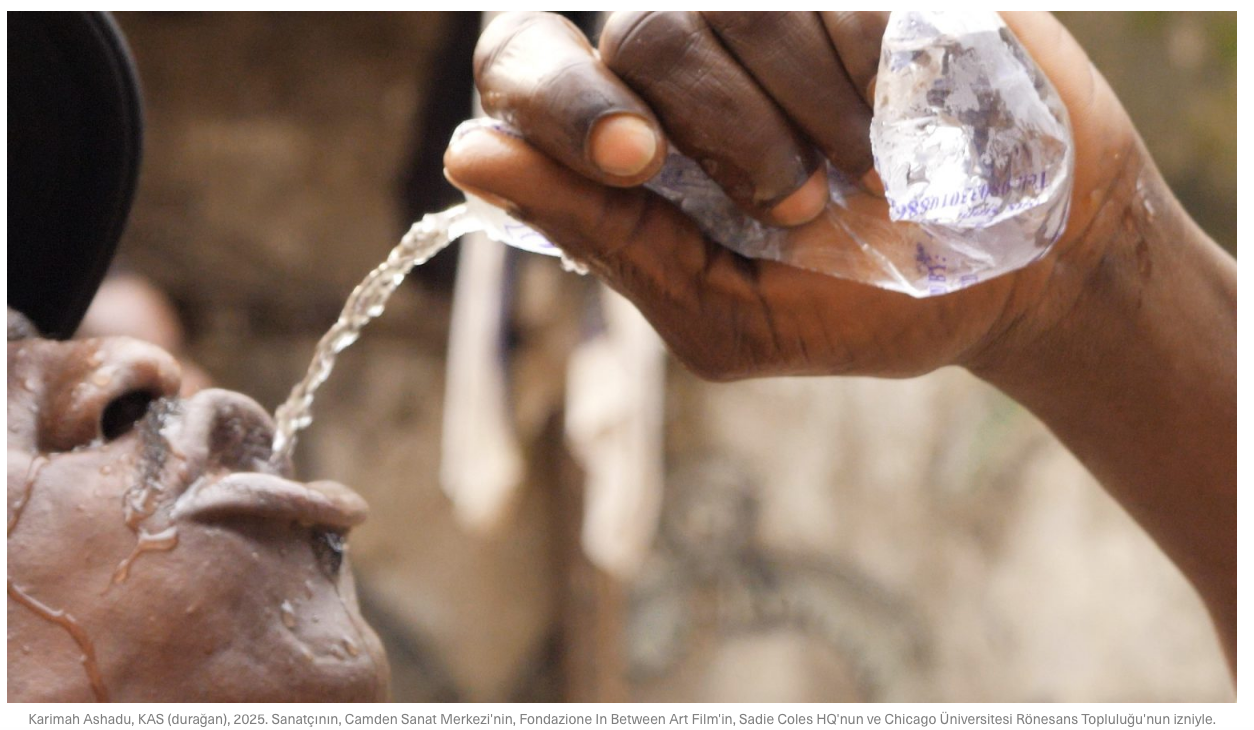
Karimah Ashadu carries the relationship that Tarr and Sachs establish with cinematic time into contemporary art's space-body focused practices. The Nigerian artist's exhibition at Camden Arts Centre addresses Lagos's urban fabric, the body's negotiation with space, and the tension created by postcolonial urbanization through video installations and photographic compositions. As Emmanuel Iduma emphasizes in his critique, Ashadu's works question the boundary between "documenting" and "constructing," transferring the observational cinema tradition to the contemporary art context. Bodies moving in Lagos's streets, markets, passages are neither completely free nor completely constrained in Ashadu's camera; they are in constant negotiation. This aligns with Henri Lefebvre's theory of "the production of space": space is not a pre-given template but a field where social relations are continuously reproduced. Ashadu's camera angle usually remains at eye level or slightly below, removing the viewer from a hierarchical position and placing them on an equal plane with the observed bodies. This is the exact opposite of the colonial gaze from above, from outside, objectifying. Ashadu visually practices Trinh T. Minh-ha's concept of "speaking nearby": speaking not about her subject but alongside her subject.
The common ground of these three artists lies in their positioning of "slowness" and "silence" not as passive withdrawal but as active intervention. Both Sachs's intimate dramas, Tarr's existential tableaux, and Ashadu's urban ethnography question the concept of "narrative" itself. Classical narrative structure setup, conflict, resolution is the aesthetic equivalent of capitalist production logic; a problem is identified, processed, packaged and consumed. These three names, however, step outside this logic by refusing resolution, sustaining uncertainty, postponing closure. Their aesthetics echo Walter Benjamin's concept of "dialectical image": past and present, hope and hopelessness, movement and stagnation are held together simultaneously, without resolution.
They also form an interesting triangulation at the compositional level. Sachs's films usually work with triangular compositions the tension between two characters is restructured through the intervention of a third element (another character, a space, an object of desire). Tarr's framing choices usually establish symmetrical yet dynamic balances around a centrally placed figure or object. Ashadu, in her three-channel video projection installations, fragments the viewer's perception by presenting different temporal and spatial layers together. This is not a reference to classical composition rules like the golden ratio; conversely, it's an attempt to break the myth of "harmony" and "balance" imposed by these rules. Their aesthetics are built on "tension" instead of "beauty," "contradiction" instead of "harmony."
On the social plane, these three names develop different but complementary reflexes against "dominance-subordination" hierarchies. Sachs, by representing queer relationships independently from heteronormative power dynamics, shows how desire itself is contaminated by ideological structures but can still seep through them. Tarr addresses rural poverty and post-socialist collapse without falling into victim narrative, giving his characters a dignity and capacity for resistance. Ashadu positions postcolonial subjects not as fitting into Western art audiences' categories of "in need of help" or "exotic," but as active subjects of their own spatial and social negotiations. All three, in their representation politics, go beyond liberal "inclusion" rhetoric to explore how bodies and experiences that are structurally excluded can create their own regimes of seeing and narrating.
The discursive landscape created by these artists carries a deep unease about the present time. While Sachs's characters try to reconstruct intimacy within neoliberal individualism discourse, Tarr's figures continue to exist in the ruins of the end-of-history narrative. Ashadu's Lagos is the scene of the most naked form of global capitalism's spatial inequalities. However, there is a glimmer of hope in all three: silence, slowness and observation carry not only melancholy or passivity but also potential for resistance and reconstruction. In the hands of these three names, cinema and contemporary art become tools that not only represent the world but propose different ways of perceiving and experiencing the world. Their common manifesto, if it were to be formulated, could be this: Stopping in an accelerating world, becoming silent in a noisy world, making the ordinary monumental in a spectacular world, these are not aesthetic choices but existential and political necessities.
Source works: Ira Sachs interview (ArtReview), Béla Tarr memorial essay (ArtReview), Karimah Ashadu exhibition review - Emmanuel Iduma (ArtReview, Camden Arts Centre)
Collecist