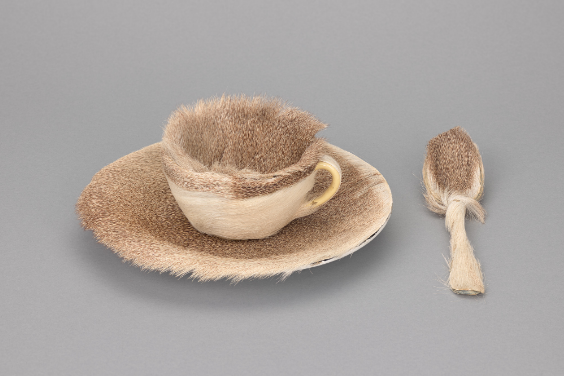
(The fur of coffee + what happened to a cup =The birth of Object)
Everything started with a joke.
1936, Paris. At a table: Picasso, Dora Maar and Meret Oppenheim.Picasso looked at Oppenheim's fur bracelet and said, "Everything can be covered with fur."
Oppenheim smiled: "Even this cup."
And she called to the waiter: "A little more fur, please."
But this wasn't just a joke.
Some time later, Oppenheim actually took a cup, a saucer and a spoon — and covered them all with fur. She gave it a minimalist name: OBJECT.
What emerged was neither quite a sculpture nor quite a tea set.You want to touch it but you don't want to drink from it.Sensual yet unsettling.Gentle yet wild.
For the first time, a teacup became so explicitly bodily.
The Surrealists talked about the unconscious, but Oppenheim put it on the table.
She took an object associated with women — the cup — and separated it from its function. She pulled it away from service, elegance, "hospitality." And left the viewer alone with this question:
Is this still an object, or is it a desire?
The softness of the fur swallows the hard porcelain. The inside of the cup is no longer for drinking but for gazing. Almost like a body turned inside out: shy yet inviting.
All the sexuality hidden beneath modern table etiquette suddenly becomes visible.
What Oppenheim did was simple but radical: Taking the everyday and making it disturbing. Colliding nature with culture. Sticking the fantasies that the female body has carried for centuries onto a kitchen utensil.
This work brought her great fame. But it also became a burden.
Because now everyone always expected "another furry thing" from her.Nevertheless, she made this note in history: Oppenheim became the first female artist to enter the MoMA collection.