
The Aesthetics of Invisibility
The Aesthetics of Invisibility
Can the Image Still Be Seen in an Age of Conceptual Inflation?
Throughout art history, the obstacles to production were always sought in familiar places: technical inadequacy, economic hardship, political censorship. Absence was what rendered the work invisible. Today, however, the problem facing art comes from precisely the opposite direction. The obstacle no longer stands before production; it lies in the limitlessness of production itself. In the age we inhabit, the work becomes invisible not through scarcity, but through abundance.
Thousands of works stream past us every day. The feed never stops; with every scroll, a new image, a new exhibition, a new open call. Yet this endless visibility paradoxically produces a kind of blindness. As Jean Baudrillard sensed long ago, where everything is rendered hyper-visible, the image loses its own meaning; excess becomes a more effective form of concealment than concealment itself. Byung-Chul Han sharpens this further: the problem of our age is not repression, but surplus. Where everything is visible, nothing is seen.
But if the matter were merely the proliferation of images, the problem would remain relatively simple. There is a more insidious inflation at work: conceptual inflation. A large share of the works in circulation today takes shape around headings such as ecology, memory, migration, identity, body, archive, artificial intelligence, visibility. None of these concepts is trivial; on the contrary, they are the genuine concerns of the age. The problem is not the existence of these concepts, but their ceaseless reproduction. There was a time when art's task was to open new fields of thought; today, art frequently becomes little more than the visual confirmation of ideas already in circulation. Exhibition texts resemble one another, artist statements revolve around the same theoretical references, and the work increasingly becomes the visual extension of a concept. Most works do not think for themselves; they borrow the prestige of thought.
A misunderstanding must be dispelled at the outset. The problem is not the concept itself; nor is it the connection that an exhibition, a selection, or a text forges with thought. Art has always walked alongside thought and will continue to do so. The problem is the automatization of thought. The transformation of a concept from a tool into a decoration, a badge, a borrowed authority. A concept can be used in two ways: either it opens a new intensity, or it takes shelter behind a ready-made prestige. The distinction lies not in which concept the work chooses, but in whether it genuinely thinks with that concept.
It is worth recalling Marcel Duchamp at precisely this point. In 1957, Duchamp said that a work emerges "raw" from its creator and is refined by the viewer; he coined the term "art coefficient" to describe that gap between what is intended and what is realized. Duchamp's true innovation was not the addition of a new concept, but the opening of an interval: a suspended void between intention and realization, between signal and reception. From the peepholes of Étant donnés to the miniature museum of the Boîte-en-valise, his works dislodge the viewer from a fixed gaze and carry them into an uncertain, permeable field of perception. Duchamp did not add noise to noise; on the contrary, he preserved the interval in which seeing takes place. The work lived in that void, in that state of suspension.
Walter Benjamin wrote that in the age of mechanical reproduction the aura of the work is damaged. In the digital age, what erodes is not only the aura but meaning itself. Within endless circulation, both image and concept are rapidly consumed. And every consumed concept leaves behind a ruin: a shell that once carried thought and now merely appears to have thought.
What contemporary art needs, then, is not to find new concepts, but to produce a new intensity. Not to speak more, but to be capable of silence once again. For sometimes a single image provokes more thought than hundreds of pages of theoretical text; and real art most often becomes visible when the noise of concepts subsides.
Collecist's first selection, "Image in an Age of Uncertainty," stood at precisely this threshold. There, uncertainty was proposed not as a theme to be consumed, but as the very condition of seeing. The point was not to send yet another concept into circulation, but to keep open an interval in which the image could once again be seen. This is what we mean by untamed production: production that resists the conceptual packaging machine's domestication of the work, its reduction of it to the visual extension of a heading. When you remove the intermediary commission, the gatekeeper, and the noise, what remains is that bare encounter between the work and the viewer.
Perhaps the future of art lies not in becoming more visible, but in becoming seeable once again. And seeing is only possible when the noise subsides. Art needs a quiet space — an interval devoted not to spectacle but to attention, not to abundance but to intensity. The art that will rise above the ruins of concepts will begin not with a new concept, but with a relearned silence.
S. Çağatay Özkefeli
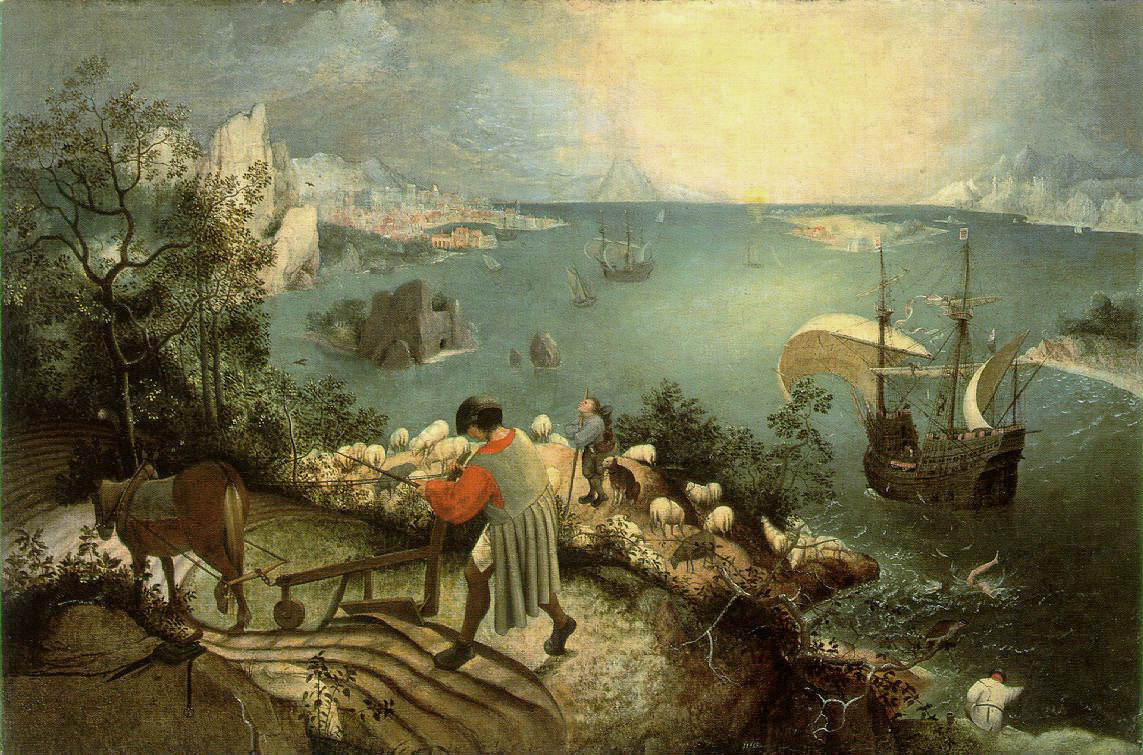
Artwork: Pieter Bruegel — Landscape with the Fall of Icarus (~1560)
Collecist — Art's Quiet Space