
When Does an Artist Look at Themselves?
Marcia Marcus and the Belated Truth the Mirror Returns
Is it possible for an artist who lived nearly a century in New York to be known by so few people until her death? Marcia Marcus's story begins exactly with this question.
In an era when abstraction was heroicized, when gesture suffocated the figure, when male myths dominated art history, Marcus persistently looked at faces. The faces of others. And more importantly, her own face. But this gaze can be read neither as narcissism nor as a romantic inward turn. Marcus's mirrors existed not to affirm beauty; but to show where identity cracks.
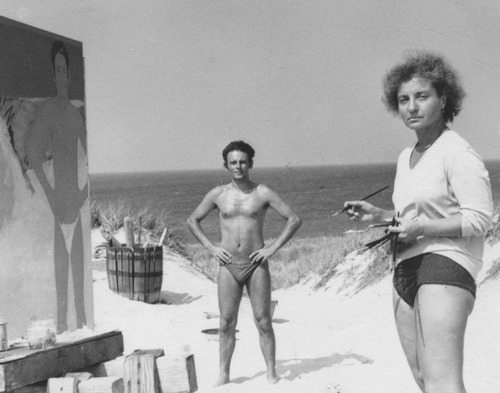
She was active in the New York art scene in the 1950s and 60s: exhibited at the Whitney, sat alone at Cedar Tavern, carried Provincetown light into her paintings. She made figurative paintings with the same courage as Alice Neel and Sylvia Sleigh, in the same period. But history books wrote other names. Marcus had deliberately chosen to remain timeless in an era when figurative painting was "timeless."
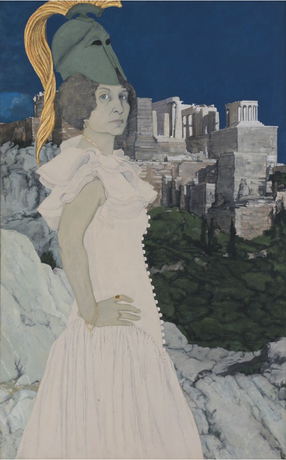
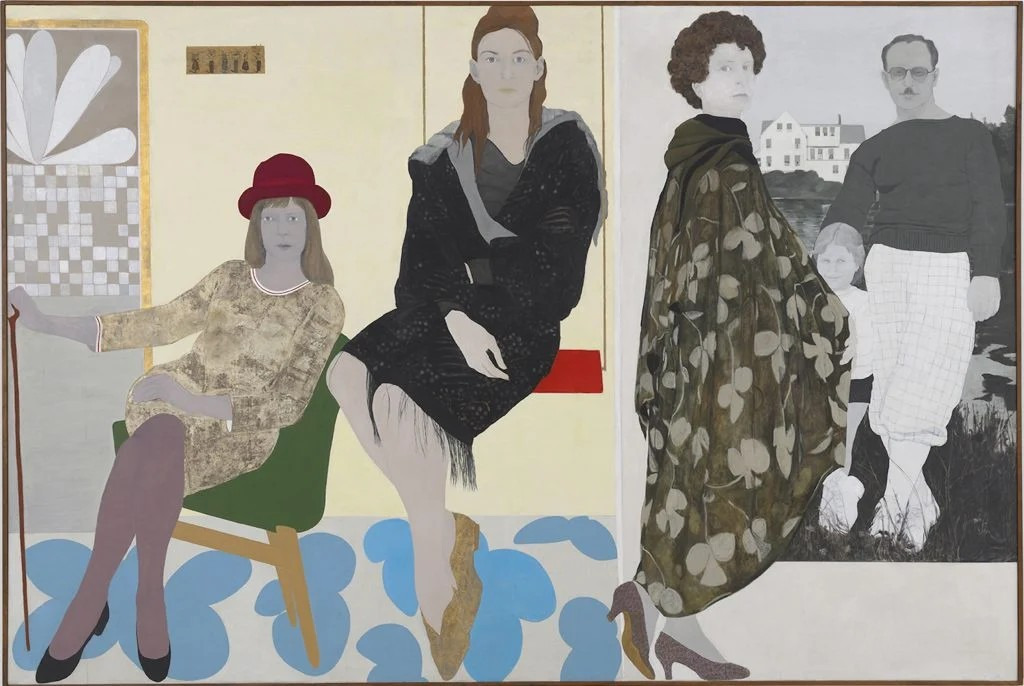
Her self-portraits are not a narrative of "self"; on the contrary, they are silent performances that expose the performability of being a woman. She becomes Athena, becomes Medusa, becomes a painter, becomes a mother — but never fully settles into any of them. Because what Marcus is interested in is the role itself: how it is worn, how it is carried, and how it is undone.
Her use of photography as a surface rather than a reference; her emphasis on the flatness of the image; her theatrical but cold compositions... All of these are a much earlier date for many issues we read through Cindy Sherman today. However, Marcus did this not through slogans, but by persistently making paintings.
Motherhood was not an interruption for her, but a space of expansion. She painted even on the days her children were born. She did not establish a hierarchy between her studio and her life. Art was not something "done when time was found" for her; it was time itself.
And then came a long silence.
Figuration fell out of favor. The market switched to another language. Marcus continued to work but was not looked at. Until years later, a painting that an advisor happened to see in Miami.
The exhibition opening today at Lévy Gorvy Dayan is not only a return; it is a belated historical correction. Marcus is now being read alongside Alice Neel and Sylvia Sleigh. In an equal sentence. Finally. But at the heart of the exhibition, there is a single painting — and it must be saved for last.
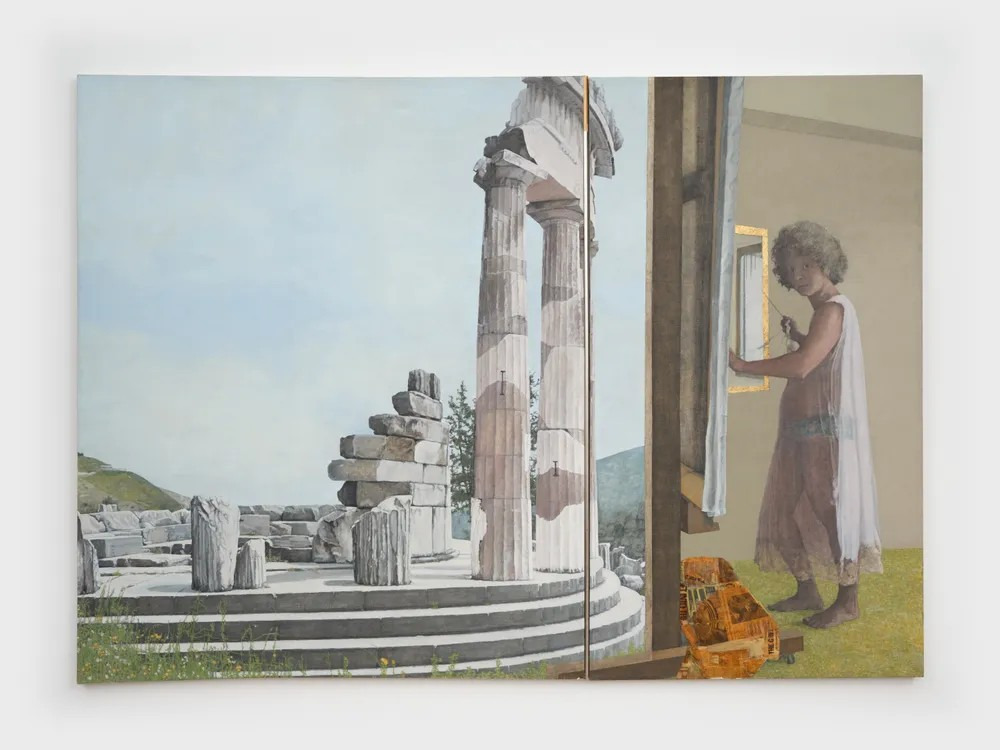
Mirror View (Self-Portrait) from 1973, spanning over eight meters.
Inside an ancient ruin, a space washed with sunlight. Marcus, wearing a transparent dress, is repositioning a gold-framed mirror beside the enormous canvas. Her gaze is turned toward us. Cold, aware, disturbingly clear.
In this painting, Marcus is neither in the role of goddess nor mother nor painter.
This time she only shows the distance between the one who looks and the one who is looked at.
The mirror is no longer a surface; it is an accomplice.
And the question is now inevitable:
When an artist looks at herself, who does she actually expose?
Marcia Marcus's belated visibility is the moment of looking in the mirror not only for an artist, but for art history as well. And this gaze is not easy.