
Despite Its Wings, a Wooden Ladder
From Jacob's ladder to the screen: on the iconography of ascent
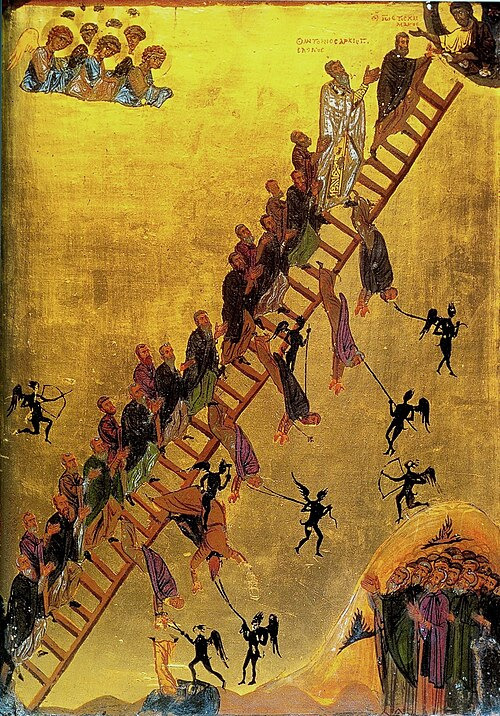
A detail
At the Monastery of Saint Catherine in Sinai, there is an icon from the 12th century: The Ladder of Divine Ascent. The composition is almost deceptively clear. A ladder stretching upward from the lower right corner, monks climbing it in a single file, small black devils pulling at them from the right, and to the upper left, a crowd of angels.
The angels fly. The monks climb.
What is not noticed at first glance is this: the beings who can fly are not helping those who climb. They are not embracing anyone and carrying them upward. They are only watching. The sky, in that painting, offers no elevator service.
Keep this detail in mind. Because the phrase "a wooden ladder despite having wings" is not an irony invented by the modern age. It is fidelity to a far older scene.
Genesis 28. Jacob makes a stone his pillow and falls asleep, and he has a dream: a ladder resting on the earth, its top reaching the heavens. And on that ladder, angels ascending and descending. They are not flying. They are using the rungs.
In the oldest image of the sky in the Western imagination, there is already a ladder. Winged beings are there, climbing despite their wings. The power of the metaphor comes not from its diagnosis of modernity, but from making visible something that has never actually changed.
There is no such thing as the anatomy of a wing
The medieval painter was not a fool. Like anyone who had watched birds, he sensed how many times larger the wingspan needed to carry a human body would have to be compared to what was depicted; Leonardo would later calculate this explicitly in his notebooks. So the wing was never an aerodynamic claim.
The wing was a sign.
According to Thomas Aquinas, the angel is an immaterial intellect; it does not travel through space, it simply is where it acts. It therefore requires no route for movement, and consequently no wing. The painter draws the wing not to keep the angel aloft, but to tell the viewer: "this being is not from here." The wing is not an organ; it is a badge of origin.
This requires us to correct the most sensitive point in our sentence. To say "we forgot how to use our wings" is too gentle a lie. We never used them. The wing was never a means of transport.
What we have lost is not a faculty, but the legibility of a sign. Our inability to fly is not new; what is new is our inability to read the sign that we might have come from somewhere else.
The sky is once again full of messengers
Angelos: messenger. The angel is not a being but a function. It carries, conveys, passes between.
Michel Serres was right when he said that angels constitute a contemporary mythology: today the sky is fuller of messengers than at any other point in history. Satellites, fiber lines, servers, couriers, notifications, algorithms. The "invisible carriers of an invisible order" that the Middle Ages imagined were actually built and placed in orbit.
The angels did not die. They were industrialized.
But there is a difference, and the matter lies precisely there. The medieval angel was inseparable from the message it carried; Gabriel without his annunciation is not Gabriel. The angel itself is made of the same substance as the meaning of the message. Today's messenger, however, is entirely indifferent to what it carries. A fiber optic cable makes no distinction between a love letter and an invoice; its indifference is its engineering achievement.
What remains of the angel is pure transmission capacity, stripped of meaning. Our loss is not wings. It is indifference.
The word "hierarchy" comes from angels
The ladder is not an innocent tool. It must lean against a wall. The wing leans against nothing; the ladder, however, is only useful if a structure exists. To climb always means first accepting the wall.
And the question of who determines the order of the rungs to be climbed takes us to an unexpected place. The word hierarchy comes from Pseudo-Dionysius's Celestial Hierarchy: the angels are divided into nine choirs, three triads Seraphim, Cherubim, Thrones; then Dominions, Virtues, Powers; and at the bottom, Principalities, Archangels, Angels.
The modern career ladder is the direct heir to this grammar. We preserved the nine ranks, changed the titles, and quietly vacated the God at the top. The architecture of the Middle Ages still stands; only the top floor of the building is now for rent.
Were John Berger here, he would ask from this point: when we stopped looking and started climbing, who remained on the side of the looked-at? Because advancing on a ladder requires keeping one's eyes fixed always on the next rung. One who looks upward cannot climb. One who climbs does not look upward.
Perhaps the reason we stopped looking at the sky is not faithlessness, but busyness.
The angel whose wings will not close
What Walter Benjamin said about Klee's Angelus Novus is the sharpest counterpart to our sentence: the angel is looking backward, toward the past; it wishes to move forward, but the storm blowing from paradise has caught in its wings and it can no longer close them. The name of the storm is progress.
Note carefully: this angel has not forgotten how to fly. On the contrary, it is precisely because its wings are open that it has been rendered motionless. Here the wing is not a faculty but an obstacle.
Half a century later, Wenders would place two angels in the skies of Berlin, and they too would desire not to rise but to descend. Damiel gives up his wings in order to taste coffee and feel blood on his hands. The angels of the twentieth century fall downward.
The direction of desire reversed itself, and no one announced it.
Scaffold
In churches there are indeed wooden ladders. But they do not belong to the angels.
They are the scaffolding erected for the restoration of a fresco on the ceiling. Every angel face we still have today exists because someone without wings climbed a wooden ladder and remained there for months, cleaning paint, filling cracks, securing plaster, fixing render — looking from a distance that could never be seen from the ground, from a closeness that was never made to be seen.
The ladder is not the defeat of the wing. It is what we construct to keep the wing visible.
The angels do not carry a ladder despite their wings. We carry the ladder in order to draw near to them.
The sky has not changed. What has changed is what we have had to build in order to be able to look at it. And like every scaffold, this one too is temporary; it will be taken down. But before it is taken down, someone must climb up there and look.
S. Çağatay Özkefeli