
Immortal Storyboard
Why Has the Odyssey Been Depicted for Three Thousand Years?
How long does a story live? Ten years? A century? Or does a story that potters, sculptors, engravers, painters, and today's film directors have never been able to stop recreating for three thousand years ever truly age?
Christopher Nolan's big-budget Odyssey adaptation is not merely a new film. It is the latest link in one of humanity's longest-running visual traditions — IMAX cameras picking up where a hand that painted a black-figure vase three thousand years ago left off.
Because Homer's epic was never solely read.
First it was depicted scene by scene on ancient Greek pottery. Then it passed into marble reliefs. The Renaissance reinterpreted it, the Romantics reimagined the Sirens and Calypso, the Symbolists turned Odysseus into a metaphor for the human mind. Today, those same scenes are on the screen.
Perhaps the true power of the Odyssey lies not in being literature, but in functioning almost like a ready-made storyboard. The cave of Polyphemus, the rocks of the Sirens, Circe's cup, Penelope's loom, the drawn bow... Each section is on its own a complete visual composition. The epic does not merely produce a text to be read — it produces images to be seen again and again. Art history, too, has followed these images for three thousand years.
Below, let us trace how even a single scene has passed from age to age.
Five Scenes That Have Been Depicted for Three Thousand Years
The Cave of Polyphemus : The First Scene Ever Depicted
One of the earliest visual traces of the Odyssey is nearly as old as the epic's first written form. The blazing stake driven into the giant's single eye offers a compositionally perfect moment of violence: outstretched arms, a body toppling backward, all movement converging on a single center. The ancient painter who chose this scene was not illustrating a text; he was simply transferring to a surface a moment that was already constructed like a picture. This is precisely where the epic's "storyboard logic" begins — the narrative points to its own most dramatic frame.
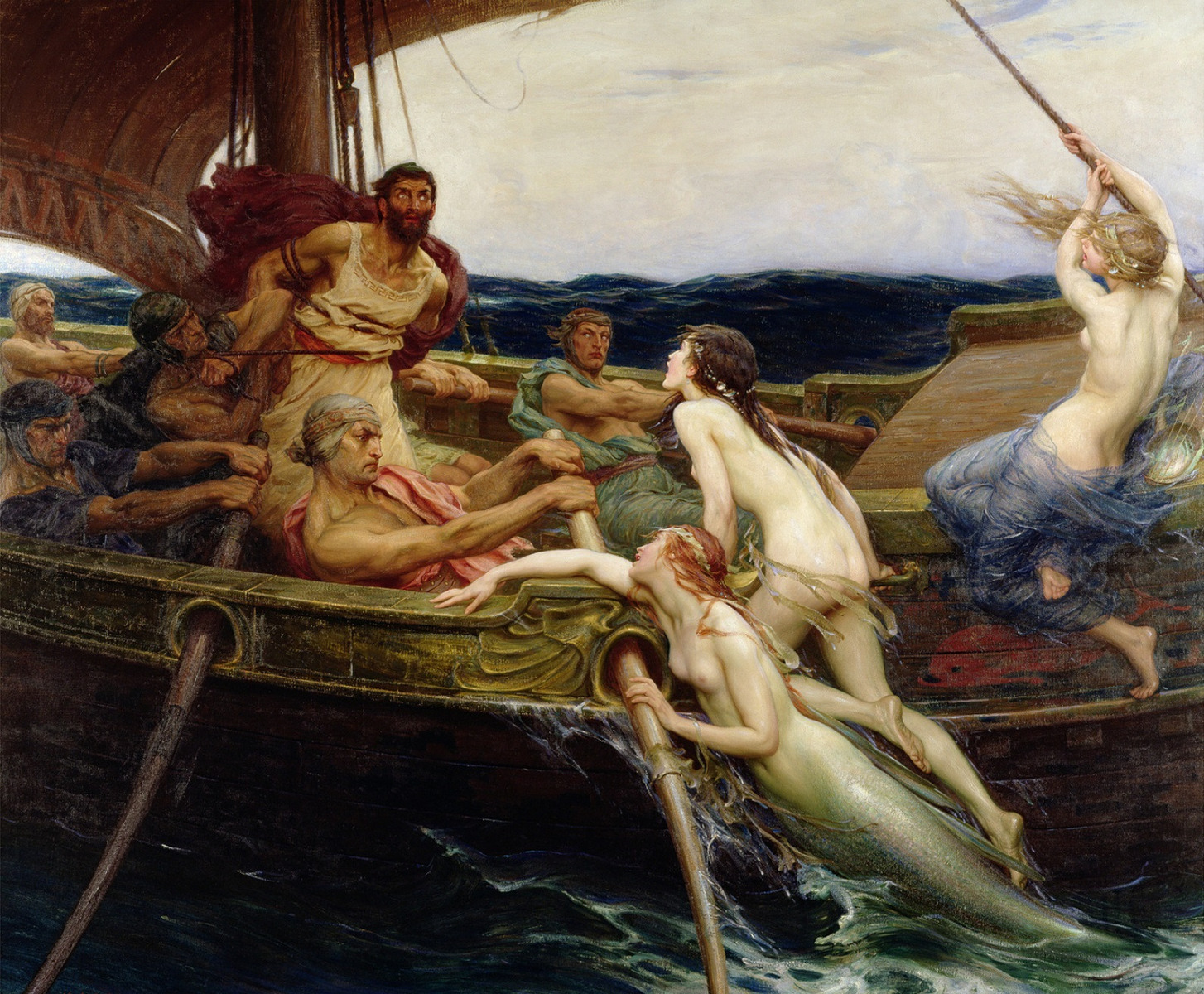
The Sirens : The Man Bound to the Mast
Perhaps the most frequently redrawn image in the entire epic. Odysseus has himself bound to the mast, stops the ears of his oarsmen with beeswax, and becomes the only man to hear the deadly song and survive. For thousands of years this scene has carried the same tension: the tension between desire and will. On the ancient vase, winged creatures surround the ship; in nineteenth-century Romantic painting, the Sirens are no longer monsters but an irresistible beauty. The same scene becomes a mirror in which each age reflects its own temptation. The image stays fixed; its meaning shifts with the times.
Circe's Cup : The Moment of Enchantment
Circe turns the men into swine with the cup she offers them. The power of the scene lies at the very center of the action, in that suspended moment when the cup is extended: nothing has happened yet, but everything is about to. Renaissance and Symbolist painters loved this "threshold moment," because painting works in precisely this way — carrying an entire fate within a frozen second. Circe reappears again and again in art history as a figure constructed as both attraction and threat.
Penelope's Loom : The Image of Waiting
The most serene, most inward scene in the entire epic. Penelope weaves by day and unravels by night, spinning a cloth that will never be finished in order to keep the suitors at bay. This is not the image of action but of patience — and interestingly, the image of the woman at the loom also becomes an allegory for the artist's own relationship with their work: to weave, to unravel, to weave again. No less than the action scenes of the Odyssey, this silent scene has drawn painters for three thousand years. Because waiting, too, is something that can be depicted.
The Drawn Bow : The Moment of Return
A stranger dressed as a beggar draws the bow that no one else could, and the epic suddenly explodes. This is the scene of recognition, of justice, and of return — the moment when a physical act (drawing the bow) resolves an entire narrative. It is visually magnificent because the tension is concentrated in a single body, a single movement. It is not hard to imagine why a director like Nolan would be captivated by this scene — cinema exists precisely for moments like this.
Some Works Become History; Others Become the Memory of Art
What has kept the Odyssey alive for three thousand years is not simply that it is a good story. Good stories are plentiful. What makes it unique is that it appears to have been written to be seen. Each section is a composition, each composition an empty frame into which any age can project its own fears, desires, and patience.
The ancient painter drew the Sirens as monsters; the Romantic painter drew them as beauty. The same mast, the same bound man, a different world. The scene never changed; the eye that looked upon it did. Perhaps this is the definition of great works: to leave behind a mold that can be filled anew by every age.
Nolan's film is the newest link in this chain, but not the last. Tomorrow, another technology and another hand will return to the same five scenes. Because long before the Odyssey was a text to be read, it was an image to be seen — and images do not die; they simply change hands.