
Image is Not Property
An art note on material, property and seeing
When looking at a painting, we think we know what we're looking at: a face, a landscape, a bowl of fruit. But what we're looking at is also what it's made with. Material stands silently beneath the image and often says more than the image itself: who made it, with what means. We hardly notice this because we consider material natural. But material is a choice; often also a necessity.
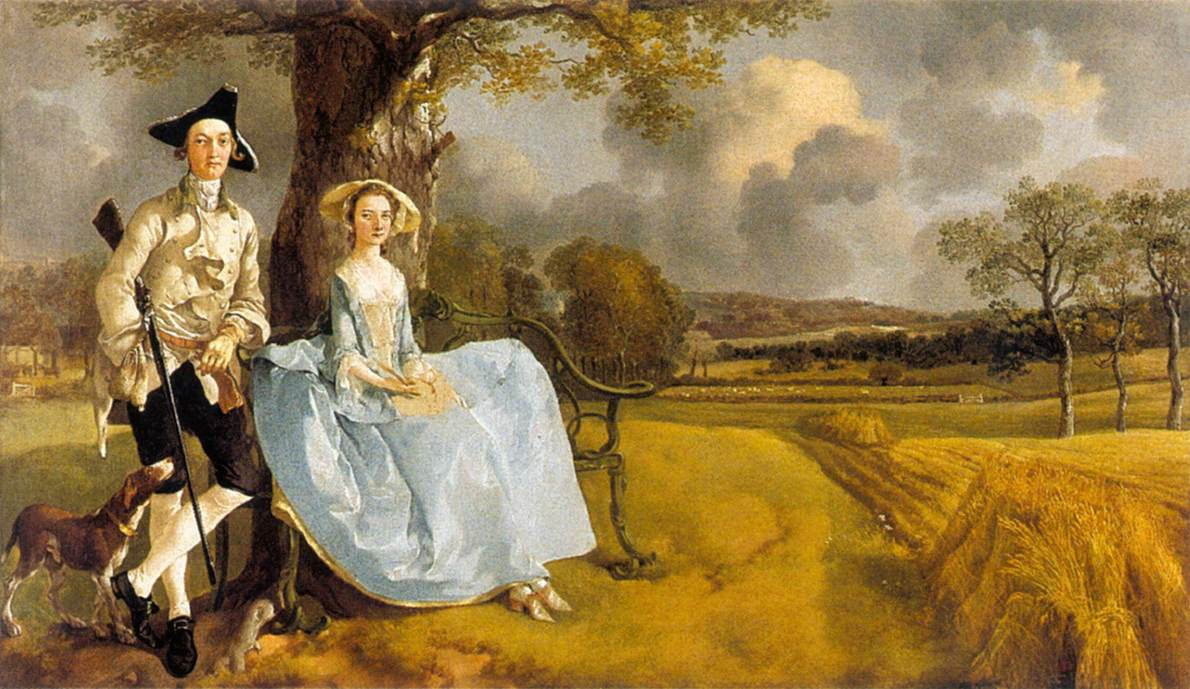
Let's look again at the Gainsborough on this page's cover, Mr and Mrs Andrews. For years we read this painting like a nature depiction: a couple sitting under a tree, with a luminous English countryside behind them. John Berger, in Ways of Seeing, disrupts this comfortable reading — the painting depicts not nature, but property. The Andrews couple stands not within the landscape, but in front of the land they own; their posture, their gaze, that rifle under the chair, all are declarations of belonging. And it's not just the pose that says this; it's the material itself.
Because for centuries, oil painting was the painting of the tangible. It could show the shine of fur, the coldness of silver, the weight of flesh; it made objects almost graspable. In Berger's words, oil painting was the language of things that could be possessed: to paint something with it was, in a way, to acquire it as property. This is why large canvas, thick paint, expensive pigment was never just material; it was a boundary that predetermined who could produce images.
Now let's cross to the other side of the boundary. Recently, in an open call, a painter described, in an almost cheerful tone, how they couldn't afford paint for large canvases. They had reduced the canvas size; now they make tiny, black-and-white works, finishing the incomplete parts of the painting with embroidery. Another spoke of an emulsion they developed at home, printing transfer prints on the cheapest paper and the result is really good.
They weren't telling this as a complaint; they were right too. Because what's happening here is beyond a budget issue. This is exactly what Walter Benjamin saw a century ago: the technically reproducible image loses its "aura" its uniqueness, its here and now existence, its possessability. The value of the oil painting was in being unique and tangible; the value of the print on cheap paper lies in being reproducible, distributable, ungraspable. Embroidery is slow, the work of patience; it shows labor, not property. So as material shrinks, the bond that image establishes with property also dissolves. The artist may be abandoning the expensive because they can't afford it; but what they're abandoning is also what made the image property.
Moreover, this isn't a new story. In 1967, when Germano Celant named a generation working with earth, cloth, newspaper, everyday and "poor" materials as Arte Povera, he read poverty not as a deficiency but as an attitude: the silent rejection of the polished, expensive, sellable art object. The painter in the open call experiences this not as a theory but as a necessity but arrives at the same place: cheap material becomes not a deprivation but a language.
When we were at the academy, everyone's budget was obvious. Getting the best result from the cheapest material was a kind of silent game. A famous professor of ours, ignoring our situation, would say "good material, good result." He wasn't wrong. But something was missing: he assumed a world where material was cheap and time was abundant. In that world, he was right. When that world retreated, the same sentence stopped being a criterion and became an admission ticket.
The issue is right here: the path to art is paved with expensive materials, not with good intentions but with invoices. Once, a workshop's rent was the equivalent of a two-hour lesson; the condition for producing images was something an ordinary person could reach. Today we have to fit the spacious hall, the comfortably walkable production space onto a tiny table. Large canvas shrank, paper cheapened, the salon descended to the table. This is not a landscape but a scale. The narrowing of the workshop is the narrowing of access to image. Whoever controls the conditions of image production also decides what will be seen. Today, the owner of production conditions has taken the place of the property owner in Berger's painting.
Yet the image still comes. On cheap paper, on a shrunken canvas, at the tip of an embroidery needle. The shrinking canvas didn't shrink the stubbornness fit into it. The needle completed where paint couldn't reach. A homemade emulsion did what the big gallery couldn't: it translated the image from the language of property to everyone's language. Just like Benjamin's reproducible image as uniqueness disappeared, access expanded.
Material was never the real issue. We learned to see only the painting when looking at a work; but we also need to see the conditions that forced that painting to this size, this material, this silent black-and-white. Seeing is often seeing the price. An image is not property no matter how expensive the material it's made with. And some of us reminded this on the cheapest paper, making their own way.
S. Çağatay Özkefeli
Collecist
Work: Gainsborough — Mr and Mrs Andrews (~1750)